ManualTK Compressor plugin →
TK Compressor
A compressor whose squeeze knob moves threshold, ratio, attack, release and makeup together the way an engineer would with one hand free - gentle bus behaviour at the bottom, properly squashed at the top. The character knob is the interesting one: it is a drive stage sitting *before the detector*, so it changes what the compressor is reacting to, not just how the output sounds. A slow button lengthens the times for anything with a body worth keeping.
The interface - every control mapped
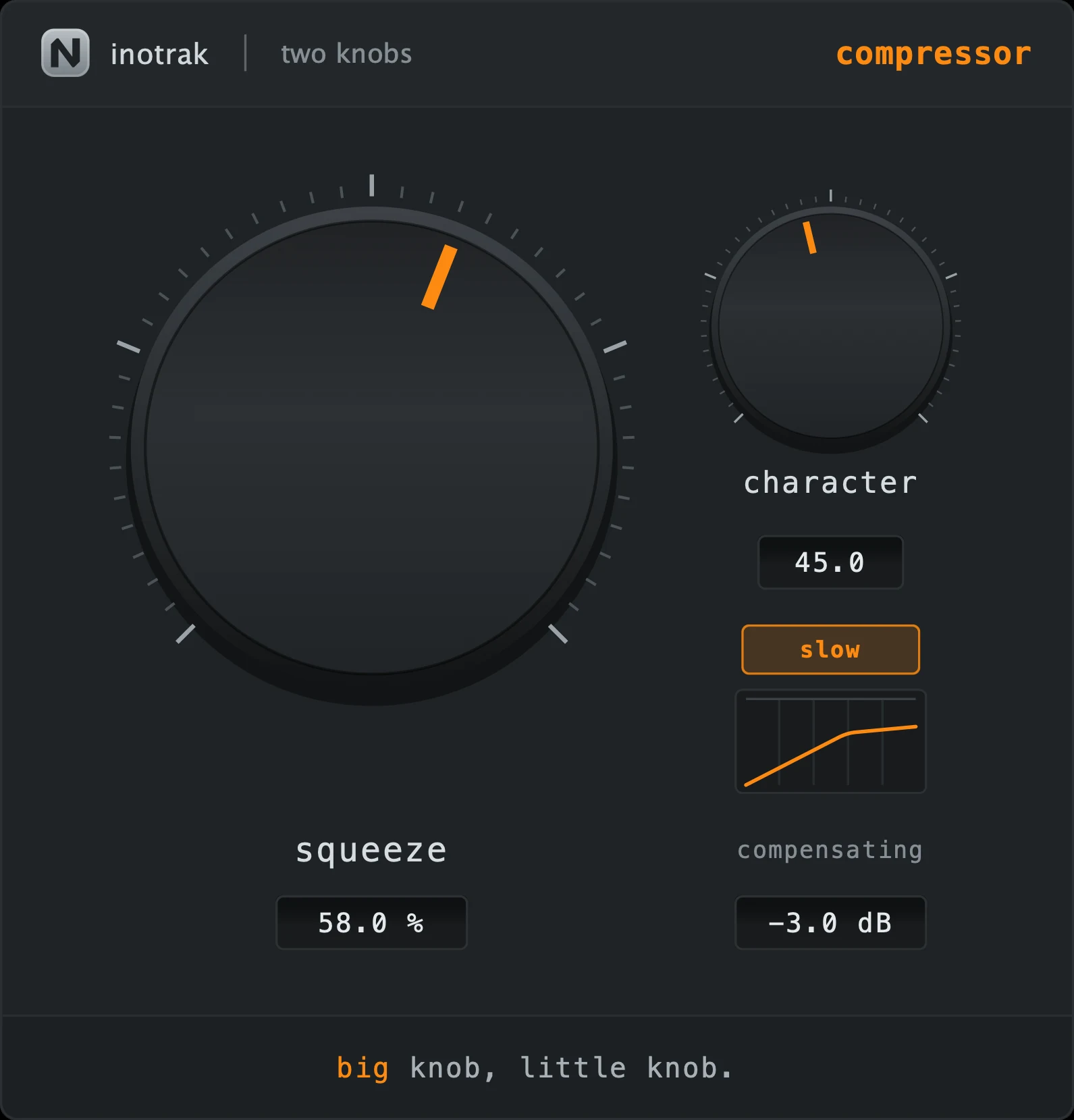 123456
Quick start
- Turn squeeze up until it is doing the amount of work you want - roughly a third for vocals, more for drums.
- Add character to change how it grabs, not just how it sounds. It drives the detector, so more of it means a different reaction, not only more colour.
- On anything with a body to protect - a snare, a mix bus - click slow (once for slow, twice for slowest).
- The level comes up a little as you add squeeze, the way a compressor with makeup does; a ceiling keeps the peaks just under 0 dBFS.
The two knobs
Threshold, ratio, attack, release and makeup, all at once. The threshold walks down while the ratio walks up, and the times shorten as it bites harder. Gentle bus behaviour at the bottom, properly squashed at the top. The makeup is sized from a reference operating level so it provably cannot out-run the gain reduction.
A drive stage that sits before the detector, so it does not just colour the output - it changes what the compressor is reacting to, and therefore how it grabs. The harmonic flavour morphs across the sweep as well, odd through both to even, so one knob is genuinely both "how much bite" and "what kind".
The button
Three speeds, one click at a time: fast (unlit), slow and slowest. Slow roughly doubles the attack and lengthens the release by half; slowest multiplies the attack by 5x and the release by 2.5x. Reach for them on anything with a body you want to keep. A snare compressed hard with the fast times becomes just a crack - the gain arrives three milliseconds after the stick and lets go before the drum has finished. Slow lets the body through first; slowest holds it down long enough not to swell back up under the decay. On a mix bus slow or slowest is usually right; on a bass DI fast usually is. A session saved before the three speeds opens on slowest, which is the old slow.
What to reach for it on
Anything. Vocals with squeeze around a third and a touch of character; drums with more of both and slow on; a bus with very little of either.
Shared across the series
The same on all six, so learning one teaches you the set.
Input is level-matched to output continuously, so turning the big knob up never simply makes things louder - you hear the effect, not the volume. The compensating readout under the little knob shows what it is doing right now: negative means the plugin made things louder and the compensation is pulling back. It takes about a second to settle after a big move, deliberately - a compensator that reacts instantly is a compressor. TK Compressor is the one exception: its level rises with squeeze (see its own section).
Drag up and down to adjust. Hold shift while dragging for fine adjustment. Double-click a knob to return it to its default. You can also double-click a value readout and type a number.
A small live curve under the little knob showing what the plugin is currently doing to the signal - the transfer curve, the filter shape or the gate contour, depending on the plugin. It follows both knobs and the toggle.
Drag any edge. The aspect ratio is locked, the range is 60 %-200 %, and the size is remembered with the session. Everything stays readable at the bottom of that range.
No preset browser, no meter, no gain-reduction display, no A/B, no settings gear. Nothing to configure and nothing shared with any other plugin - these hold no cross-plugin state and behave identically with none of the rest of the suite installed.