ManualTK Distortion plugin →
TK Distortion
A distortion whose single drive knob walks through five different characters as it climbs - clean, odd harmonics, even, both, then a digital one at the top - crossfading between them so the tone *morphs* rather than switching. It gets weirder as it climbs, not just dirtier. A spectral tilt after it takes the result dark or bright without moving the middle of the spectrum - and a row of six frequencies under the drive knob picks where it pivots, so “dark” can mean fatten the bottom or de-fizz the top. A toggle picks which digital extreme the top of the sweep arrives at.
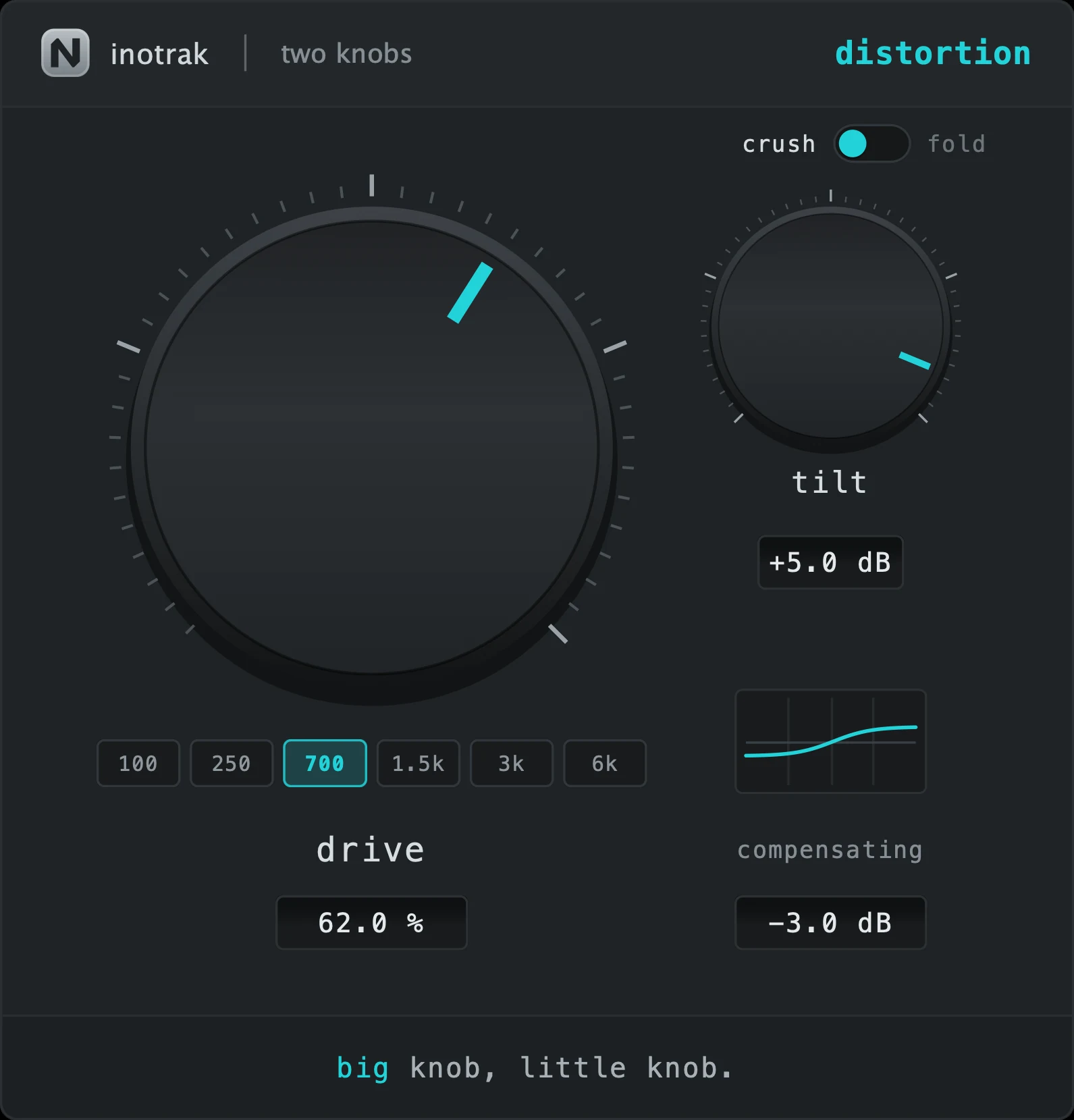
The interface - every control mapped
 123456
Quick start
- Put it on the source and turn drive up until the character is the one you want - the four long ticks mark where it changes.
- Use tilt to place the result: down for dark, up for bright, flat in the middle.
- Pick the pivot from the row under the drive knob if 700 Hz is not where you want the spectrum to rotate - 6k to de-fizz, 100 to work on weight.
- If you have pushed drive past three quarters, try the crush / fold toggle - below that point the two sound identical.
- Do not compensate the level by ear - it is already matched. Judge the character alone.
The two knobs
Both how hard and what kind. It walks through five characters as it climbs - clean, then odd harmonics, then even, then both, then a digital one at the top - crossfading rather than switching. Low is a console-ish edge, halfway is tube-flavoured warmth, three quarters is both at once and starting to bite. The four long tick marks are the only ticks in the series that mean anything: they mark where the character changes.
A spectral tilt sitting after the distortion, calibrated in dB. Down is dark, up is bright, flat in the middle. Because it is a tilt rather than a tone control, the middle of the spectrum stays put - you are pivoting the balance, not adding or removing level.
The toggle
Picks what the top of the drive sweep arrives at. fold is a wavefolder several folds deep - the transfer curve turns back on itself and the harmonic series stops being a series - and it gets more extreme on everything. crush is a bit crusher that works the other way round: loud material comes back close to clean while quiet material (decays, tails, room) turns grainy. Both want the whole top of the knob, so you get one at a time. Below three quarters of drive the two positions sound identical.
The pivot row
Six frequencies under the big knob. Where the tilt pivots — which is what decides what "dark" and "bright" mean.
The point the spectrum rotates about. 100 is weight against everything - dark fattens the bottom, bright thins it. 250 is body against everything above, the classic "mud or not" pivot. 700 is body against presence, balanced, and the default. 1.5k works on attack and presence against everything below. 3k is bite against the rest - dark tames harshness the drive just added. 6k is air only: it takes the fizz off without dulling the body, which is the job none of the lower pivots can do and the one a distortion actually needs. Nothing above 6k, deliberately - the shelves are broad enough that a higher pivot puts the whole audible band on one side of it and lands within about a decibel of the 6k setting.
What to reach for it on
Room mics, a DI bass that needs teeth, a drum bus you want to sound like it went through something, a synth line that is too polite.
Shared across the series
The same on all six, so learning one teaches you the set.
Input is level-matched to output continuously, so turning the big knob up never simply makes things louder - you hear the effect, not the volume. The compensating readout under the little knob shows what it is doing right now: negative means the plugin made things louder and the compensation is pulling back. It takes about a second to settle after a big move, deliberately - a compensator that reacts instantly is a compressor. TK Compressor is the one exception: its level rises with squeeze (see its own section).
Drag up and down to adjust. Hold shift while dragging for fine adjustment. Double-click a knob to return it to its default. You can also double-click a value readout and type a number.
A small live curve under the little knob showing what the plugin is currently doing to the signal - the transfer curve, the filter shape or the gate contour, depending on the plugin. It follows both knobs and the toggle.
Drag any edge. The aspect ratio is locked, the range is 60 %-200 %, and the size is remembered with the session. Everything stays readable at the bottom of that range.
No preset browser, no meter, no gain-reduction display, no A/B, no settings gear. Nothing to configure and nothing shared with any other plugin - these hold no cross-plugin state and behave identically with none of the rest of the suite installed.