ManualTK Dynamic EQ plugin →
TK Dynamic EQ
A single-band dynamic EQ reduced to where and how much. The intensity knob moves threshold, range and bandwidth together, so pushing it means more action in every sense - the band reacts sooner, moves further, and covers more ground. A toggle picks the direction: cut dips the band when its own energy pokes out, prick lifts it while it is weak and backs off once it is strong.
The interface - every control mapped
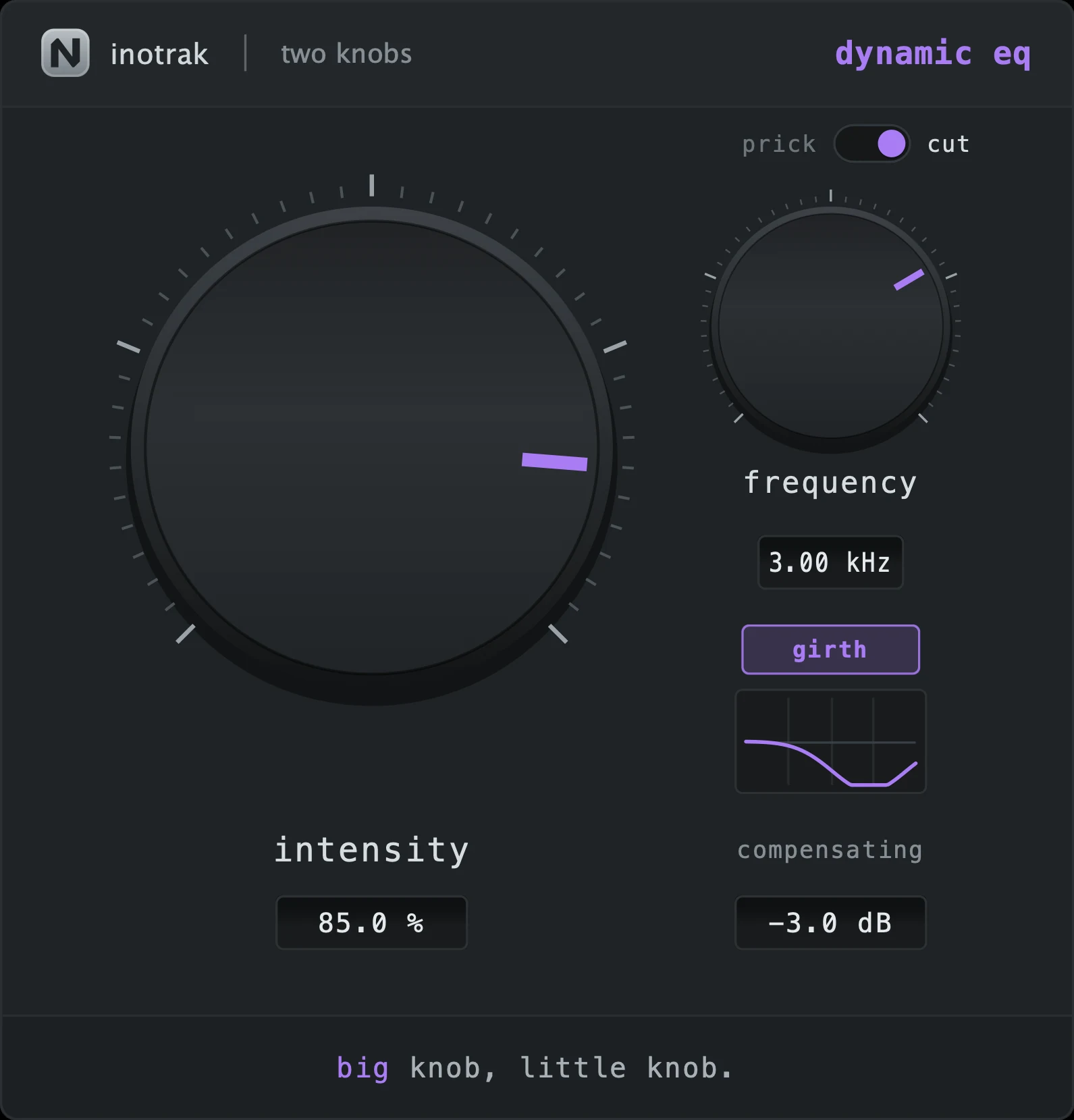 1234567
Quick start
- Sweep frequency to the problem - it is continuous, with no stepped selector.
- Turn intensity up until the band is doing the amount of work you want. At zero the plugin is inert.
- Pick a direction: cut for a resonance that only shows on loud notes, prick for something that vanishes in the quiet passages.
- If the problem is a whole region rather than a single note, turn girth on to widen the band.
The two knobs
Threshold, range and bandwidth, together. Pushing it means more action in every sense: the band starts reacting sooner, moves further when it does, and widens as it goes. A fixed narrow band would cap how much of the signal the move can reach, so sweeping the width is what makes this knob mean more action rather than just a deeper notch. At zero the plugin is inert.
Sweeps the full band continuously, 30 Hz to 18 kHz. There is no stepped selector.
The toggle and the button
cut is downward - the band dips when its own energy pokes out. Use it for a resonance that only shows up on loud notes, a boxy tom, a harsh 3 kHz that only bites on the belted lines. prick is upward - the band lifts while it is *weak* and backs off once it is already strong. Use it to bring out something that disappears in the quiet passages without making the loud ones brighter.
Widens the band further, on top of whatever width intensity has already chosen. The intensity-driven width is right for one resonance and too narrow when the problem is a whole region rather than a single spot - a low-mid smear rather than one ringing note. Same idea, and the same name, as the de-esser button.
What to reach for it on
A resonant acoustic guitar, a snare with one ringing note, a boxy tom, a vocal that loses its air when the singer backs off (prick, up top).
Shared across the series
The same on all six, so learning one teaches you the set.
Input is level-matched to output continuously, so turning the big knob up never simply makes things louder - you hear the effect, not the volume. The compensating readout under the little knob shows what it is doing right now: negative means the plugin made things louder and the compensation is pulling back. It takes about a second to settle after a big move, deliberately - a compensator that reacts instantly is a compressor. TK Compressor is the one exception: its level rises with squeeze (see its own section).
Drag up and down to adjust. Hold shift while dragging for fine adjustment. Double-click a knob to return it to its default. You can also double-click a value readout and type a number.
A small live curve under the little knob showing what the plugin is currently doing to the signal - the transfer curve, the filter shape or the gate contour, depending on the plugin. It follows both knobs and the toggle.
Drag any edge. The aspect ratio is locked, the range is 60 %-200 %, and the size is remembered with the session. Everything stays readable at the bottom of that range.
No preset browser, no meter, no gain-reduction display, no A/B, no settings gear. Nothing to configure and nothing shared with any other plugin - these hold no cross-plugin state and behave identically with none of the rest of the suite installed.