ManualAnalyser plugin →
Analyser
An FFT mix analyser that doesn’t just *show* you problems — it *fixes* them. It sits first in every track’s chain, gain-stages the raw signal, and builds one live picture of how the whole mix fits together (where tracks mask each other, where they cancel in phase). Then, on a single ANALYSE pass, it computes and pushes bespoke settings to every Stig, Denzel, Zuul and Tyson in the session. The coordinating hub the rest of the suite reads from.
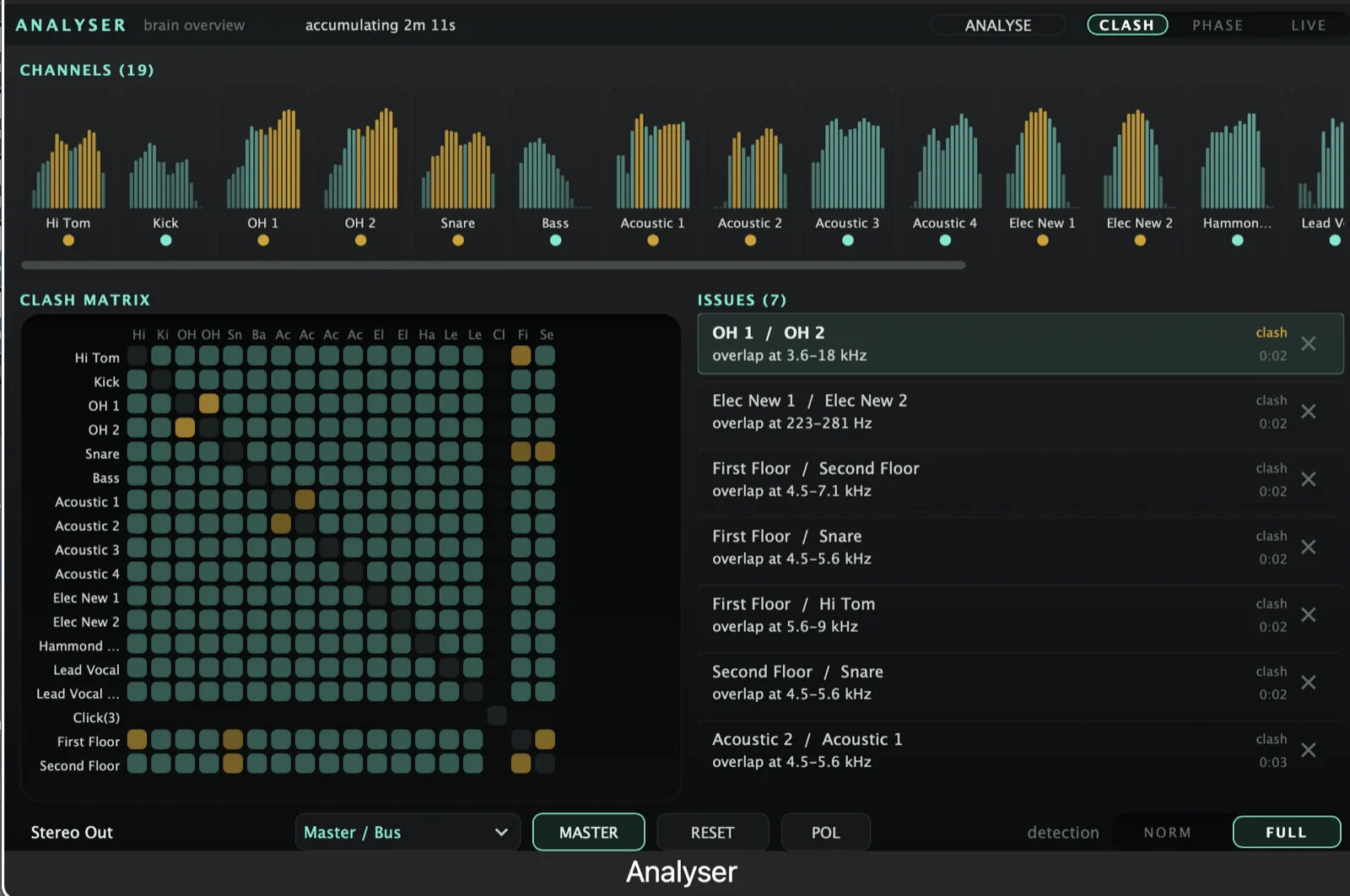
Master / brain-overview mode — the whole-mix dashboard (a demo session)
 12345678
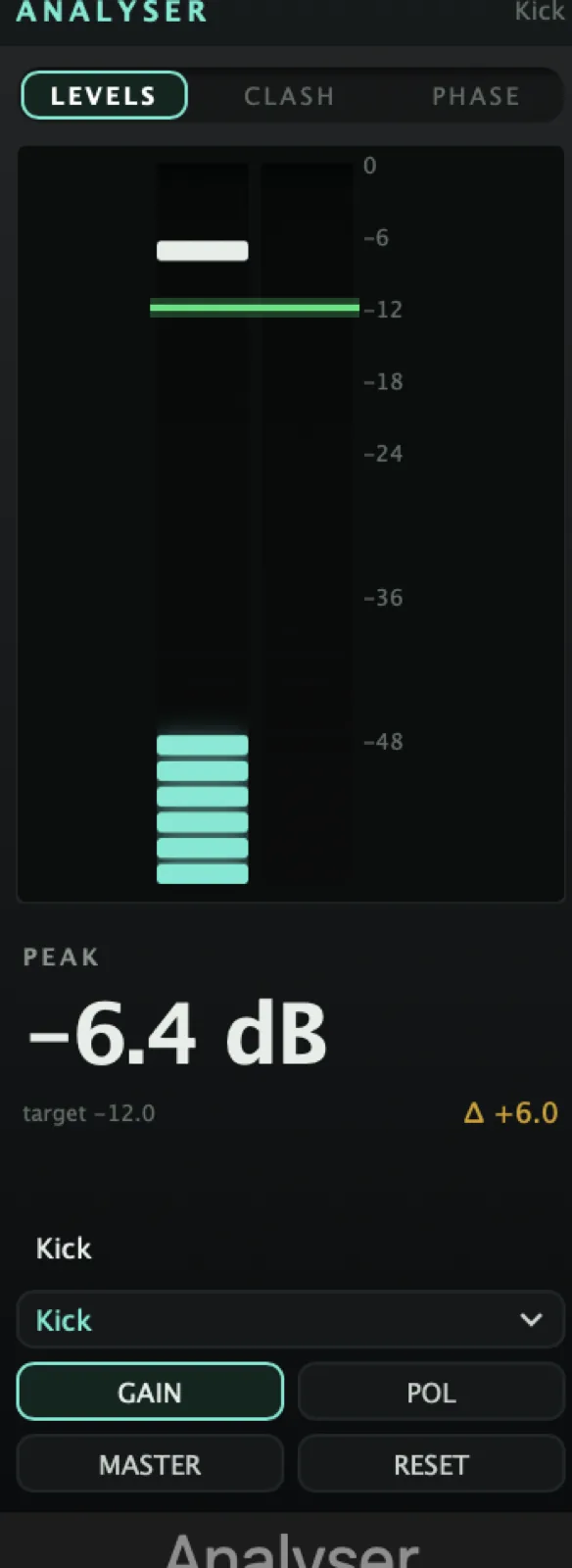
Channel-strip mode — on a track (live: Kick, gain-staging active)
 12345678
Quick start
- Insert Analyser first on every track you want the suite to coordinate — before any EQ or compressor.
- Leave track-type on auto (it reads the DAW track name) or set it by hand from the dropdown.
- Leave the gain button on — it brings the raw input to a sensible working level for everything downstream.
- Promote one instance to master to get the whole-mix overview, then use ANALYSE to set up every Stig / Denzel / Zuul / Tyson at once.
Modes & display
Analyser is two tools in one, switched by the master toggle.
Switches between channel-strip mode (compact per-track meter + spectrum) and master / brain-overview mode (the whole-mix dashboard). Promote exactly one instance to master.
Strip layout offers Levels / Clash / Phase. Master layout’s matrix offers Clash / Phase / Live. A session saved on Live and reopened on a strip clamps back to Phase.
A rolling short-window phase read for mic-placement work — rebuilt from the last N frames every refresh, immune to RESET by design. Numbers move within seconds as a mic is nudged. Hold-time preset selector offers 5s / 10s / 20s (each paired with a matching rolling window).
Track type & gain-staging
The one place gain-staging lives in the suite.
Reads the DAW track name and classifies it (Kick, Snare, Bass, Vocal, Guitar, Keys…). This drives the whole suite’s defaults. Override manually from the type dropdown.
Brings raw input to a per-type body target (Vocal −11 dBFS, Drums −21, Electric Guitar −18, Master bus a fixed −6) on the audio thread with a 20 ms ramp, so downstream EQ / compression always see a consistent level.
Clash, phase & audition
Cross-track masking and cancellation, accumulated over time — not a single-frame snapshot.
Accumulates instantaneous spectral masking between every pair of tracks and reports where they fight, by frequency range and severity — “when you both play, how badly do you collide”.
Per-band correlation against a nominated reference track; flags destructive cancellation.
Solos just the flagged frequency band of a finding across the two tracks involved; every other track is silenced. Ends into a −20 dB safety dim.
Norm/Focused (only findings with real weight — default) or Full/Thorough (also borderline issues, dimmed). Persisted by value: sessions saved before the 2026-07-24 reorder reopen in the opposite mode (accepted).
Every finding with ignore / reset, persisted per session.
Coordination & output
The primary setup path. Runs a timed measurement pass over the playing session, then computes and pushes custom EQ + compressor + gate + de-ess settings to every Stig / Denzel / Zuul / Tyson that accumulated audio.
Per-instance polarity invert.