ManualB-Root Bass Amp Sim plugin →
B-Root Bass Amp Sim
The G-Root ordered-rack amp, bass-voiced, with a SPLIT front end: an LR24 crossover divides the input into a SUB band and a HIGH band. The sub is heavily compressed and goes STRAIGHT to the output (it never hits the rack); the high band is compressed and driven through the full bass amp + pedal rack, then the two sum to mono. Drive the top as hard as you like without ever muddying the low end. Same drag-in pedal rack as G-Root, plus a bass-only Bass Drive. Self-contained — no shared brain.
The interface - every control mapped
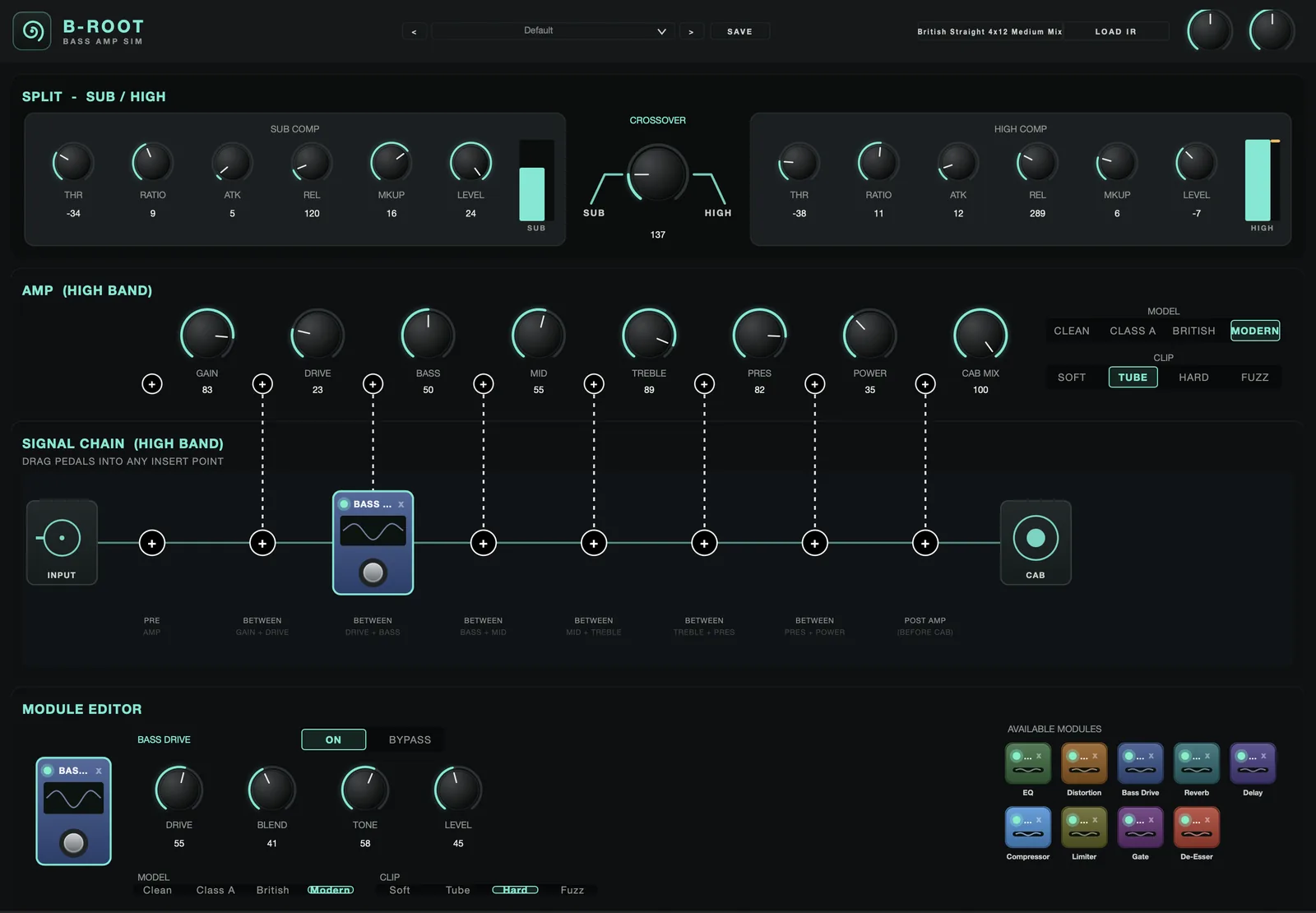 12345678910111213
< > step presets.Quick start
- Insert on the bass track.
- Set the CROSSOVER to split sub from high (roughly 100-300 Hz).
- Dial SUB COMP (heavy — holds the low end solid) and HIGH COMP (musical); each has Thr/Ratio/Atk/Rel/Makeup/Level and its own meter.
- Voice the AMP (HIGH BAND) — Gain/Drive/tone stack/Power, Model + Clip, and DRIVE RANGE (LOW for cleaner tones) — and drag pedals into its SIGNAL CHAIN insert points, exactly like G-Root. A new B-Root opens with an empty board.
- Balance the SUB / HIGH band levels, set the SYNTHETIC BASS CAB (or load a cab IR), and set MASTER in the header.
Split — Sub / High
An LR24 (Linkwitz-Riley, 24 dB/oct) split at the input, roughly 100-300 Hz, zero latency: everything below feeds the SUB path, everything above the HIGH path.
A smooth opto-ish compressor on the sub band — Thr · Ratio · Atk · Rel · Makeup · Level with a SUB meter. Heavy by default to keep the low end planted.
The same compressor on the high band — Thr · Ratio · Atk · Rel · Makeup · Level with a HIGH meter; musical by default. It feeds the amp rack.
The compressed SUB band bypasses the rack entirely and sums directly with the processed HIGH band — this is what lets you distort the top hard without losing or muddying the fundamental.
Amp (high band) + rack
Gain / Drive / Bass / Mid / Treble / Pres / Power / Cab Mix + Model + Clip + DRIVE RANGE (HIGH / LOW, as on G-Root), voiced for bass — this processes the HIGH band only.
The same drag-in pedal rack as G-Root — labelled insert points before every amp stage; drag from the PEDALS palette, click a pedal to put it on the bench, drag to reroute/reorder, x to remove, plus the same SERIES / PARALLEL branch, REJOIN and per-pedal OUT trim. It all runs on the HIGH band, so a parallel branch rejoins in the high band too, before the sub is summed back — the sub path stays untouched whatever you do in the rack.
A bass-only palette pedal (Darkglass-style): Drive · Blend (parallel clean/dirty) · Tone · Level with its own Model + Clip. Grinds the low-mids while Blend keeps the clean underneath.
Pedals & branch routing (the same rack as G-Root)
Every pedal is SERIES (in the chain) or PARALLEL - the SERIES / PARALLEL chips in ROUTING, beside the bench. A parallel pedal taps the signal where it sits, processes a private copy and mixes it back in later — the main chain carries straight on underneath, so it ADDS rather than replaces. REJOIN picks where the copy returns: PRE-CAB sends it through the speaker cab with everything else, POST-CAB rejoins after the cab so the branch is raw and un-cabbed. MIX sets how much of the branch you hear. REJOIN and MIX are dimmed while the pedal is in SERIES, where they do nothing. The rack draws the branch as a white line running out of the pedal and back into the signal.
Every pedal has an OUT knob (in ROUTING), -24 to +24 dB. It is applied after the pedal and before the parallel mix, so it sets a parallel branch’s level as well as a series one. Bypassing the pedal returns the trim to unity, so bypass stays properly transparent.
Three static peaking bands (low / mid / high), freq + gain each.
Nine fixed bands, one slider each, ±15 dB - on the bench it shows as nine vertical sliders. G-Root: 100 · 200 · 400 · 600 · 800 · 1.6k · 3.2k · 4.5k · 6k Hz. B-Root: 60 · 120 · 250 · 500 · 750 · 1k · 2.5k · 4k · 6k Hz. Its level is the OUT knob every pedal has. The three-band EQ is still there beside it.
Drive · Tone · Level · Mode (Soft / Tube / Hard / Fuzz) — oversampled, zero latency.
Reverb (Mix · Decay · Size · Damping · Type Plate/Room/Hall · Predelay) and Delay (Time · Feedback · Mix · Tone) — the Wallace / Tackleberry cores as compact mono pedals.
Compressor (Threshold · Ratio · Attack · Release · Makeup), Limiter (Threshold · Release · Ceiling — instant, ceiling-clipped, no lookahead) and Gate (Threshold · Range · Attack · Release · Hold) — the Stig / Hodor / Zuul cores.
Freq · Threshold · Amount — Tyson’s subtractive band, one band.
A resonant sweep into fuzz: Pedal · Rate/Sens · Reso · Drive · Mode · Blend. Because there is no treadle under your foot, Mode picks how the sweep moves — Manual parks it (the cocked-wah sound), Auto opens it with your playing dynamics, LFO sweeps it continuously. Rate/Sens is the LFO speed in LFO and the sensitivity in Auto. Drive at 0 is clean.
Rate · Depth · Shape · Duty · Mode · Level. Shape morphs the wave continuously from a smooth sine to a hard square; Duty skews it, so short duty with a hard shape is a stutter and long duty is a swell. Mode: Amp (classic level chop), Harmonic (the brownface trick — the low and high halves move in opposite directions, so the tone rocks dark-to-bright rather than loud-to-quiet) and Bias (breathes and adds harmonics rather than chopping). Free-running in Hz — there is no host tempo sync yet.
Digital destruction: Fold · Crush · Rate · Tone · Mode · Blend. Mode picks the shaper — Fold (the signal reflects at the rails, adding a new harmonic series per fold), Wrap (jumps hard to the opposite rail — the nastiest), Rectify (octave-up fizz) and Sine (rich but rounder). Crush drops the bit depth from 16 to 1; Rate decimates the sample rate down to 500 Hz. It is deliberately not anti-aliased — the inharmonic ring is the effect.
Cab & output
The cab button names the current cab — SYNTHETIC BASS CAB (extended low) or a loaded IR. LOAD IR loads your own cab impulse (persists with the session, level-normalised so any IR sits at a consistent loudness); clicking the cab-name button reverts to the synthetic cab. CAB MIX blends it.
Sub / High LEVEL knobs balance the two paths; in the header, IN trims the input and MASTER sets the output after the sum, each beside a horizontal meter (IN’s mark is -18 dBFS).