ManualDI Regan plugin →
DI Regan
A mono acoustic-DI channel strip: it turns a thin, quacky acoustic DI (piezo / magnetic / SBT) into a mic’d acoustic through a PA in a room. A full series chain — Input → Quack Tamer → Guitar IR → 4-band Saturator → Compressor → Anti-Feedback → PA/Room → Output. Part of the suite but completely standalone (no brain, no shared state).
The interface - every control mapped
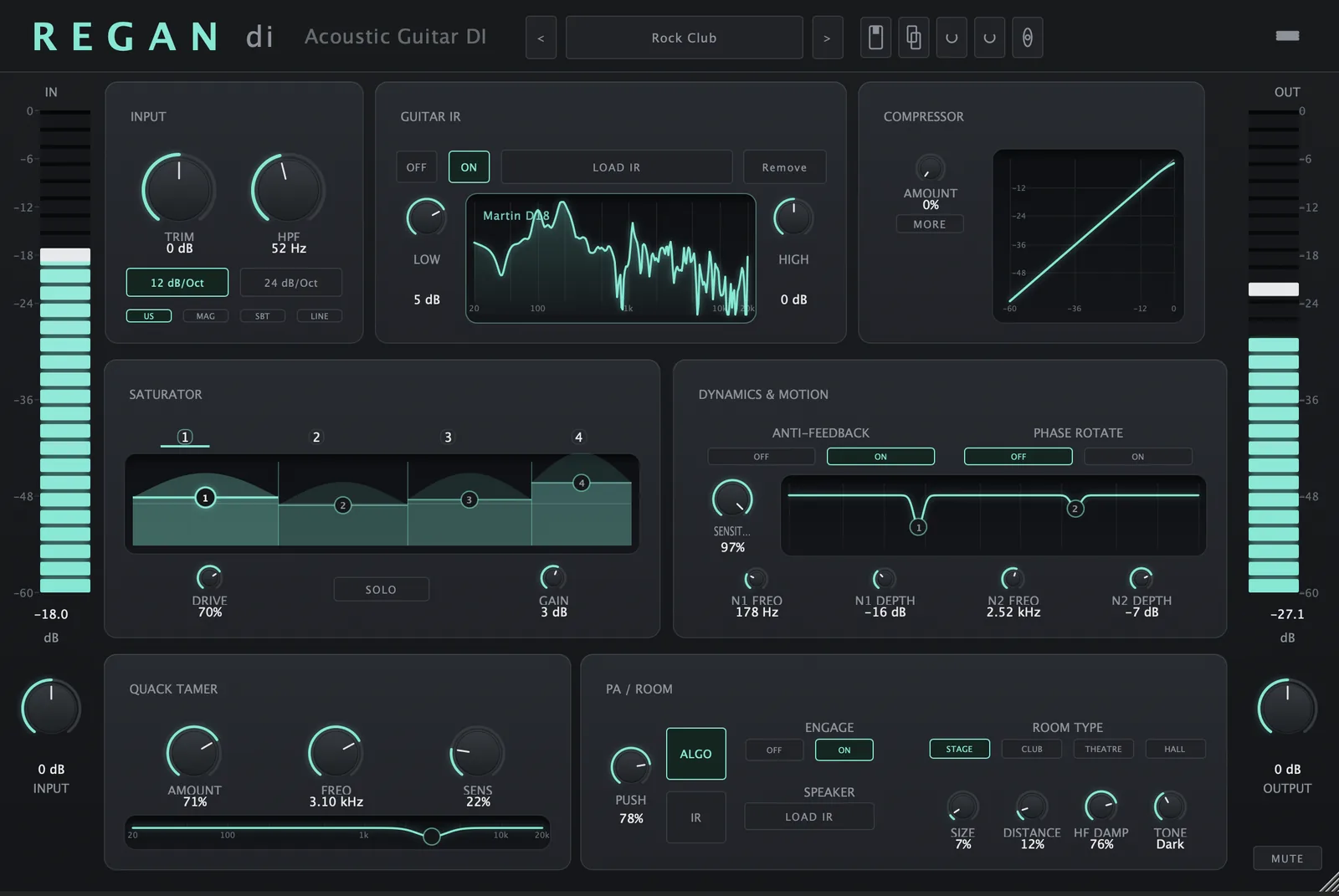 1234567891011
< > step them, the name opens the menu; save · copy · undo · redo · options.Quick start
- Insert on a mono acoustic DI track; set the Pickup type (US / MAG / SBT / LINE).
- Clean the input: HPF + Trim, then load or pick a Guitar IR (the body/mic core).
- Dial the 4-Band Saturator and Compressor to taste (it’s a full series strip — no dry/wet blend).
- Optional: engage PA / Room for the “amplified in a space” voicing; add Push for moving air.
Input & Quack Tamer
Input gain (−24…+24 dB), phase invert, and a high-pass with a 12 / 24 dB/oct slope switch.
US / MAG / SBT / LINE — voices the strip for your source and sets the Quack Tamer defaults; filters the guitar-IR browser (does not hard-gate loading).
A dynamic dip over the piezo “quack” region — ducks on transients, leaves sustained tone alone (not a static notch). Amount / Freq (1.5–4 kHz) / Sens.
Guitar IR & Saturator
Zero-latency convolution — the body/mic core. ON, the IR picker (embedded factory IRs or *Load from file…*), Remove, and Low / High trims for the IR extremes.
Linkwitz-Riley crossovers into one shared, oversampled saturation curve. Three moveable crossovers = four bands; per band Drive (loudness-compensated — pushing changes tone, not level), Gain, Solo (for dialling).
Compressor & Anti-Feedback
Gentle, program-dependent, acoustic-voiced glue. Amount macro (auto makeup) with Ratio / Attack / Release / Makeup always on show for detail; a live transfer-curve graph.
Catches resonant peaks (including ones the IR itself creates) before the room adds reflections. OFF/ON + Sensitivity (a bank of auto-hunting notches) and Phase Rotate for extra gain-before-feedback.
PA / Room & Output
The final “arriving in a space through a PA” voicing. Engage (section master), Speaker ALGO vs IR, Room Type Stage/Club/Theatre/Hall (algorithmic), Push (LF-weighted saturation + level-dependent compression — the “moving air” no IR reproduces), and Size / Distance / HF Damp / Pre-Delay / Tone (Pre-Delay: 0-40 ms before the room’s reflections arrive). Distance also sets wetness (further = wetter) — there is no separate room-mix knob.
Trim (output level) and Mute. Mono in → mono out throughout; zero added latency except the saturator oversampling (reported to the host).