ManualThe Stig Compressor plugin →
The Stig Compressor
A clean, modern VCA compressor with real character stages — not an emulation of one classic box. Transparent when you want it; but the **pre-drive saturates *into* the detector (so drive changes how the compressor grabs, not just the tone), and the post-stage adds Drive / Bitcrush / Wavefolder** after it — from subtle harmonic thickening to full destruction.
The interface - every control mapped
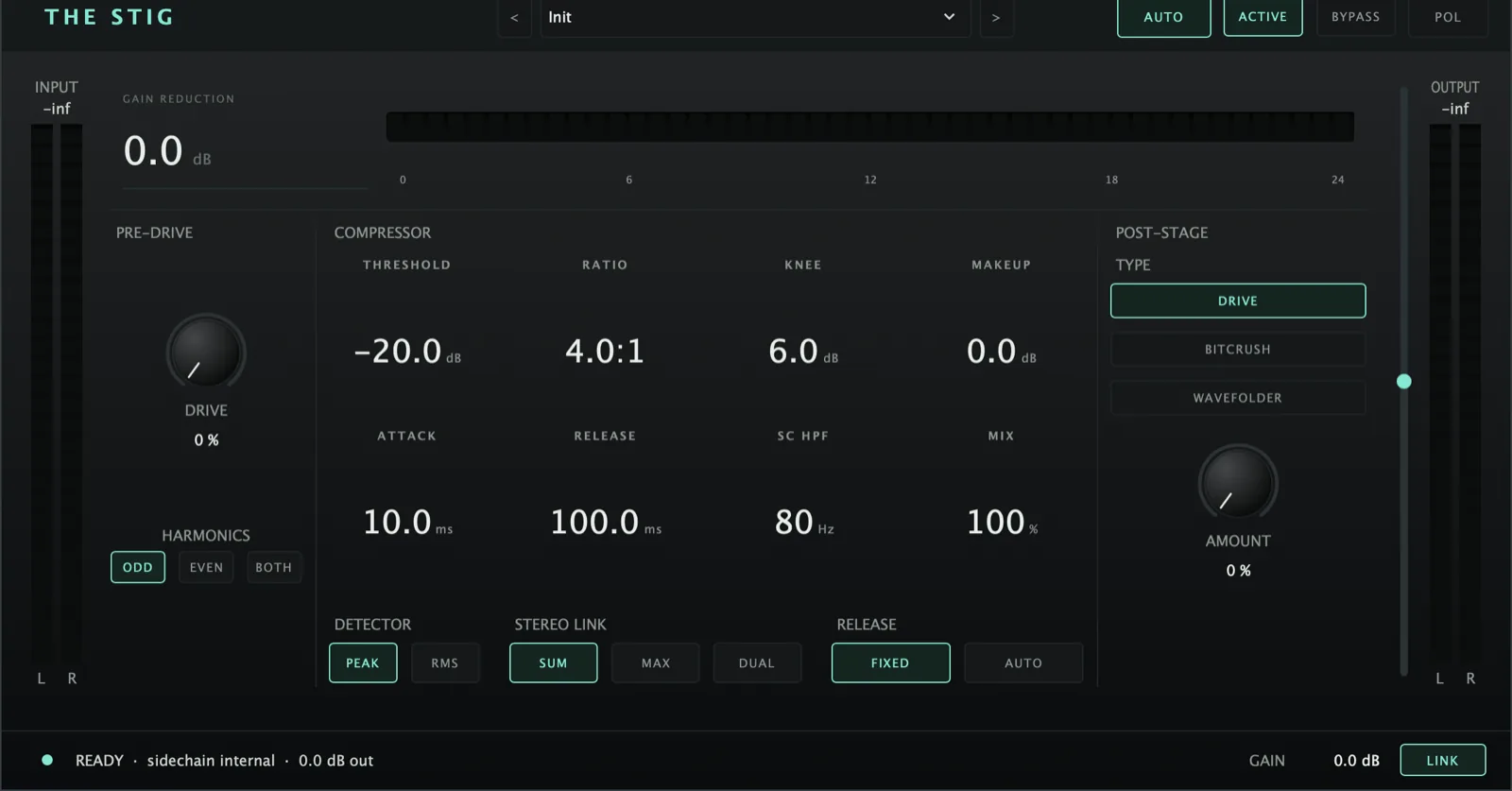 1234567891011
< > steps them.Quick start
- Put it after Analyser in the chain.
- In the suite, run ANALYSE on the master Analyser to have a setting computed for this track — or load a preset by hand. AUTO is off by default.
- Set Threshold for the gain reduction you want (watch the GR meter), then taste with Ratio, Attack, Release.
- Bring level back with Makeup, or pull Mix back for parallel compression.
Compressor core
Where compression starts. Lower = more. Watch the GR meter.
How hard, 1:1 (off) to 20:1 (limiting).
0 dB (hard, punchy) to 24 dB (soft, gentle).
0.1–100 ms. Slow lets transients through (keeps beater/pluck); fast grabs everything.
Caps how fast the level may come back up, in dB per second (Off at the top). Release alone recovers fastest right after a deep duck; Rise turns the recovery into a steady fade-up — made for a sidechained orchestra or pad swelling back under a vocal.
0–20 ms. Delays the audio while the detector hears it (or the sidechain key) straight away, so the compression is already moving when the sound arrives. Adds that much latency, which the DAW compensates. 0 ms = off, no latency.
10–1000 ms, with optional Auto Release that adapts to the material (good on vocals and bus).
Adds back the level lost to compression.
Sidechain high-pass 20–500 Hz — stops low end driving the detector. Essential on bass and full mixes so they don’t pump on every low note.
What the compressor listens to: Int is the track; Ext is the external sidechain input chosen in your DAW (duck a bass from the kick, a pad from the vocal). SC HPF still applies. The key track is picked in the DAW’s sidechain menu.
Peak (follows transients — drums, percussion) or RMS (averages level — vocals and bus, so it rides the body of the sound, not the spikes).
Sum L+R / Max L+R / Dual Mono — how the two channels are detected. Keep stereo sources linked so the image doesn’t wander.
Character
Saturation into the compressor so drive and detection interact. Harmonics switch: *Odd* (symmetric tanh, aggressive), *Even* (asymmetric bias, warm tube-style, DC-blocked), *Both* (blend). Bias scales with drive, so all three are identical at zero drive.
Colour after the compressor: Drive (harmonic warmth→grit), Bitcrush (bit-depth + sample-rate reduction, lo-fi/digital), Wavefolder (fold distortion with symmetry, synth-like, extreme).
How much of the post-stage.
OFF / 2X / 4X / 8X, in the switch strip. Runs Pre-Drive and the Drive post-stage at that many times the session rate, so a hard drive on bright material (cymbals, an “s”, the top of a guitar) stays clean instead of picking up harsh, out-of-tune grit. New instances open at 4X; a session saved before this switch existed opens at OFF, exactly as it sounded. Adds up to 32 samples of latency at 2X, 4X or 8X alike (the DAW compensates), and none at OFF. With both drives at 0 it changes nothing but that delay. Full Drive on very bright, loud material still keeps a little grit at 4X; 8X takes most of it out.
Output & suite integration
Wet/dry blend. 100% = straight compressor; pull back for parallel compression (smash hard, blend under the dry) with no second bus.
Signal invert and active/bypass.
Defaults OFF. There is deliberately no auto-apply the moment the DAW names a track — that fired before any audio had played, so it could only ever apply the same safe default. Settings arrive from the master Analyser’s ANALYSE pass, which lands on every Stig regardless of this toggle; turning AUTO on catches a track that was not playing during that window, and applies the compressor the brain computed for this track by name. Brain-controlled set, nine parameters: threshold, ratio, knee, attack, release, makeup, SC HPF, pre-drive amount and post-drive amount — the drive amounts are non-zero on the types that want character (kick, snare, toms, bass, electric guitar, rooms, drum bus) and zero on overheads, keys, vocals, BVs and the master bus. The Harmonics switch, the post-stage type, Mix, Stereo Link, Detector and Output are always yours. The first knob you touch turns AUTO off.
Output gain is the fader beside the OUT meter; the OUTPUT number under the meters sets the same thing. LINK (on by default) matches output to input by writing the Output fader half a second after you stop turning a dial, so drive and makeup change character, not loudness.
One face. Pre-Drive, Compressor (settings as draggable numbers in small screens), Post-Stage, then a meter bridge: IN, GR (hangs from the top), OUT, the Output fader and LINK. A strip of switches below. A selected button lights up white; the light beside THE STIG goes dark on bypass. The earlier modern face and the silver CLASSIC faceplate are gone.
Categories Drums, Bass, Guitars, Keys, Vocals, Bus, Mastering, Character, browsable as sub-menus, steppable with < >. Remembered by name with the session.