ManualTyson De-Esser plugin →
Tyson De-Esser
A dual-band de-esser / ess-restorer built on a subtractive split-band engine — at rest y = x exactly, so there’s no phase smear on non-sibilant material. Each band can De-ess (remove) or Enhance (restore) sibilance, with a Temper control (STONED ↔ CLEAN ↔ RAGE) that lifts and colours each band. A brain consumer, and the satellite side of Tyson Group.
The interface - every control mapped
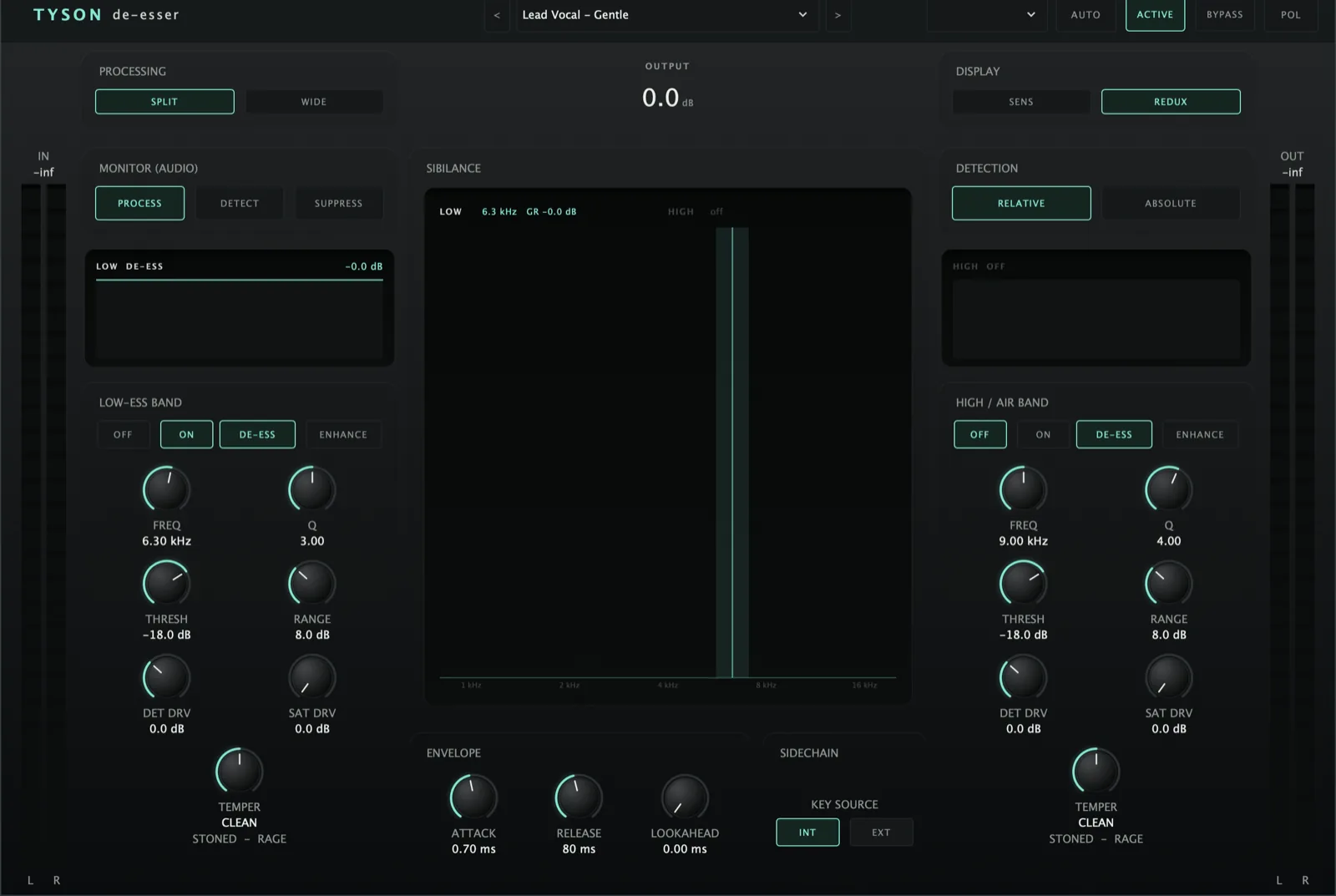 123456789101112
Quick start
- Insert on the voice; set each band’s Freq / Q over its sibilance (Low-ess ~4–8 kHz, High/Air ~7–16 kHz).
- Leave Detection on Relative so it triggers on sibilance, not loud vowels.
- Set Threshold and Range per band; use Monitor → Suppressor to hear exactly what’s being removed.
- Optional: switch a band to Enhance to restore a weak ess, and dial Temper for character.
Per band (Low-ess / High-Air)
Two independent sibilance bands. The subtractive engine isolates each with a constant-0 dB band-pass and subtracts a fraction back, so the removed signal is exactly x − y.
De-ess (downward, remove) or Enhance (upward, restore). Enhance is a genuine reverse de-esser: the relative detector fires on an “sss” *regardless of loudness*, so a weak/lispy ess can be lifted back in.
Threshold (relative or absolute) and Range = max action for that band.
Colours the band. CLEAN (centre) leaves it untouched; STONED or RAGE lift it and add a little distortion, RAGE more than STONED. It adds rather than removes, so it keeps presence while de-essing *and* puts more back when enhancing.
Det Drive gains into the detector (set sensitivity by drive, not threshold). Sat Drive turns Temper up: a bigger lift on the band, up to about 10 dB at full. It does nothing while Temper is at CLEAN.
Detector, monitor & display
Relative compares band level to broadband, so it fires on sibilance not loud vowels (the “doesn’t lisp on sustained notes” default). Absolute thresholds the band directly. Gated below −70 dB so silence shows no phantom reduction.
Split subtracts the band (default, phase-correct). Wideband ducks the whole signal by the combined band gain (classic wideband grab). Soften/character apply to the split path only.
Routes what you hear: Process / Detector (the band key) / Suppressor (the removed sibilance — the “am I lisping?” check). Falls out of the same maths, no separate audition DSP.
Scope overlay over a live spectrum with each band’s coverage stripe: Sensitivity (detector level vs threshold, lit bright when triggering) or Reduction (De-ess bar hangs from top, Enhance bar grows from bottom in cyan). Each band also has its own scrolling activity strip.
Lookahead knob (0 ms = off, no separate toggle) delays the through-signal so a fast ess is caught. Key Source Internal/External sidechain.
Brain & stack coordination
Reads a bespoke de-ess by track name (getComputedDeEssByName). Measurement-driven: finds each voice’s sibilant peaks where the HF pokes above its own local envelope — two singers at 6 kHz vs 8 kHz get different bands — and sets centre/Q/threshold/range/envelope from how far it pokes and how much of the mix already carries that region. Returns nothing for non-sibilant sources (kick, bass…).
Joins the tg::StackRegistry by the GROUP field, posts per-band sibilance + an HF profile, and reads back a continuous per-band budgetScale applied as a smoothed multiplier on the *applied* reduction (detector untouched — no measurement feedback). The budget only engages with 2+ members or a coordinator present. Orthogonal to LevelsBrain AUTO — use both at once.