ManualWallace Reverb plugin →
Wallace Reverb
A reverb built on a custom 8-line feedback delay network (Plate / Room / Hall), feeding Denzel’s dynamic-EQ + multiband-distortion engine applied to the wet signal only, with a per-band external sidechain. Brain-free in v1.
The interface - every control mapped
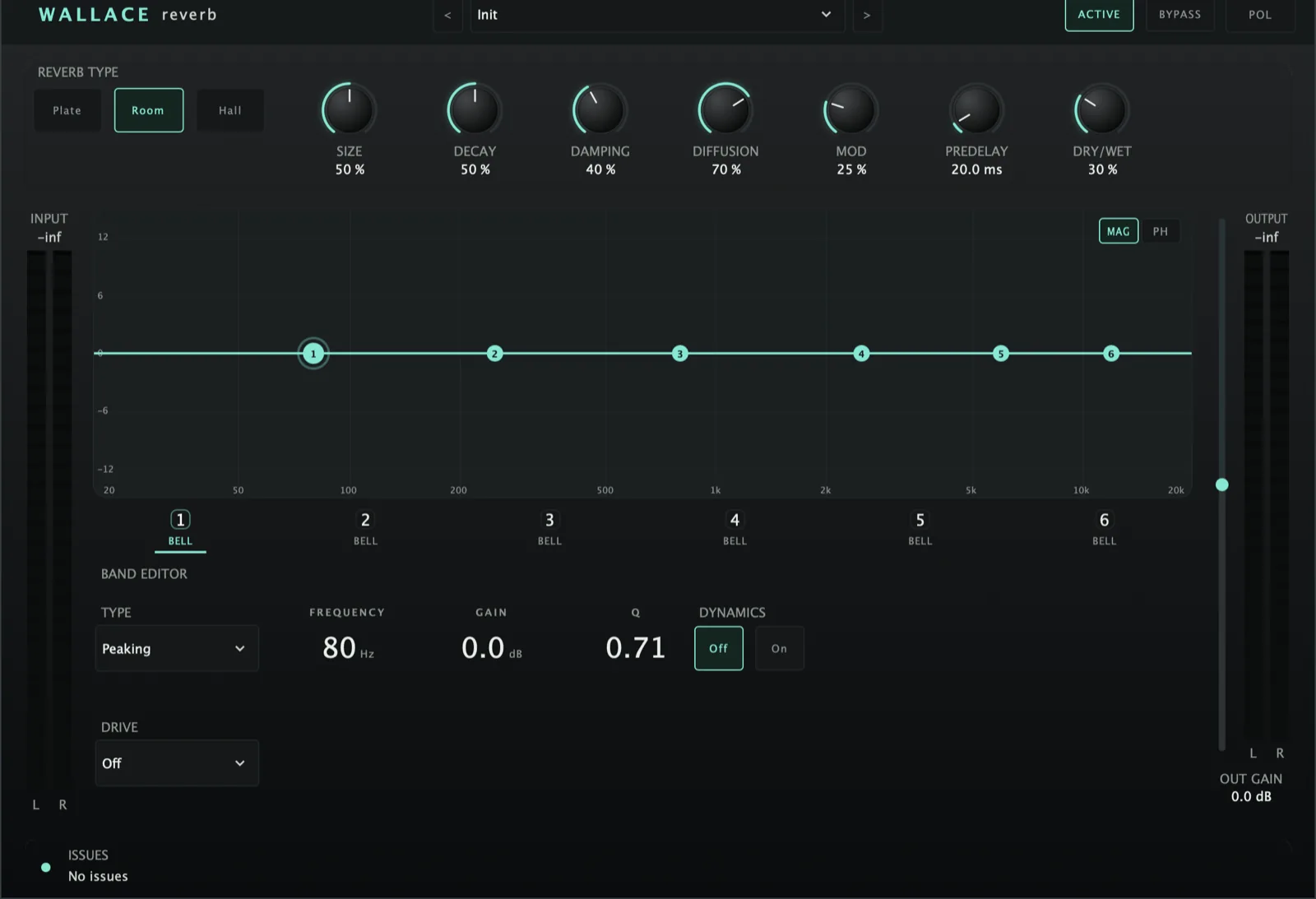 12345678910111213
Quick start
- Insert on a send/aux (or an insert with Wet/Dry pulled back).
- Pick a type (Plate / Room / Hall), set Decay (RT60) and Predelay.
- Shape the tail with Size, Damping, Diffusion, Modulation.
- Optionally EQ / drive the wet with the six dynamic bands — e.g. duck the tail from the dry source via a band’s SC toggle.
Reverb core
Plate / Room / Hall — FDN tunings (base delay scaling, Decay→RT60 range, tonal damping bias).
Tail length.
Scales the delay-line lengths (space / density).
How much faster highs decay than lows.
Input-diffuser allpass amount (smooths the onset).
Per-line delay LFO depth — breaks up metallic ringing on sustained / tonal input.
0–250 ms delay line in front of the FDN.
The final mix (last reverb knob). out = dry·(1−mix) + wet·mix, then output gain + polarity.
Wet processing (Denzel engine)
The EQ + distortion shape the wet only; the dry path is untouched.
The curve has two views. MAG is the familiar magnitude response. PHASE swaps in a −180°..+180° grid on the same log-frequency axis and draws the wet EQ’s own summed phase response, including the low cut — drawn from the exact same coefficients as the audio, so what you see cannot drift from what you hear. Useful for seeing what a steep cut or a high-Q bell is doing to the tail’s phase.
Static + upward/downward dynamic EQ on the wet tail (identical to Denzel’s engine).
Per-band drive shapers Saturate / Drive / Bitcrush / Wavefolder, oversampled where needed.
Each dynamic band can key detection off an external sidechain input instead of its own energy. Standard use: duck the reverb tail from the dry source. Falls back to internal detection when nothing is routed.
A high-pass on the wet signal only, 0–500 Hz (fully left = Off), on the meter bridge. The setting always existed; the rack face is the first to give it a control.