ManualZuul Gate plugin →
Zuul Gate
A modern gate / expander / ducker — one engine, Gate or Ducker mode, with an internal or external sidechain detector (own HP/LP + Listen), Peak/RMS/Auto detection, lookahead, open/close hysteresis, a shaped envelope and creative range tools. A brain consumer with a bespoke computed gate in AUTO.
The interface - every control mapped
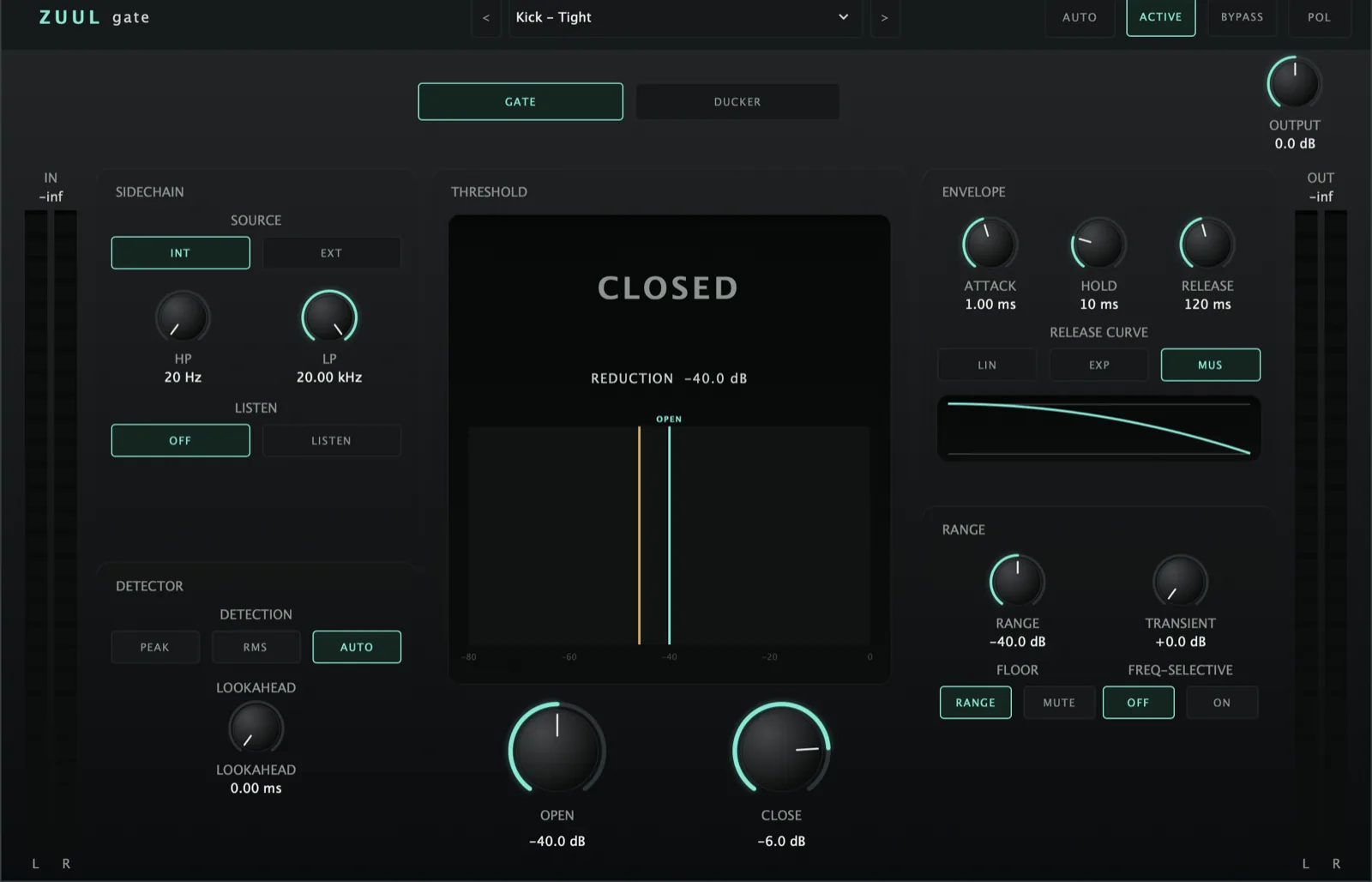 12345678910111213
Quick start
- Insert after Analyser; pick Gate or Ducker mode.
- Set the Open threshold to meet your loudest wanted hits, and Close a range below (the gap is the anti-chatter window — drawn on the meter).
- Tune the detector: HP/LP filter (use Listen), Peak/RMS/Auto, and lookahead for fast transients.
- Shape the tail with Attack / Hold / Release (+ curve); or run AUTO for a gate the brain computes from measured level/crest/spectrum.
Detector & sidechain
Mono sum of the internal input or the external sidechain bus (may be disabled / mono / stereo).
12 dB/oct Butterworth HP (20 Hz–2 kHz) and LP (200 Hz–20 kHz) on the detector path only (never the audio). Listen routes the filtered key to the output to tune by ear.
Peak (fast follower), RMS (~15 ms window), or Auto (crest-factor hybrid — peak on transients, RMS on sustained).
Gate action
Opens above Open, closes below Close (= Open + a ≤0 offset). The gap is the anti-chatter window, drawn literally on the threshold meter with the live detector level.
Flips the rest/engaged target: in Gate the loud state passes (engaged = unity); in Ducker the loud state attenuates. Everything else is shared.
Attack (one-pole) toward the engaged gain, Hold latches the open state, Release shaped by Linear / Exponential / Musical (the last slow-then-fast for natural tails).
When closed, the floor is the Range value — or full silence with Hard Mute.
0–10 ms, latency-reported to the host and bypassable. The detector reads the live key while audio is delayed, so the gain change lands slightly before the transient.
Creative extras
A short, fast-decaying leading-edge boost (0–6 dB) fired on the open edge. Off by default.
When closed, attenuation isn’t flat — a low/high-shelf tilt (fixed 250 Hz / 4 kHz corners) deepens as the gate closes, so cymbal bleed goes darker rather than just quieter. Open signal is left uncoloured. LOW / HIGH stay on screen, dimmed, until it’s switched on.
Reads a bespoke gate the brain computes from the channel’s measured data (thresholds from actual RMS/peak, hysteresis & envelope from crest, HP/LP bracketed to where energy sits) — so two snares with different tunings get different gates. Applies on the master ANALYSE broadcast and when its own AUTO is on. Any gate-shaping edit drops out.