guide
Gain staging, and why it still matters
Gain staging means setting the level at each point in a signal chain so that every device sees the level it was designed for. Modern DAWs mix in 32-bit float and will not clip internally, but any plugin modelling analogue behaviour still responds to input level. Aim for an average around -18 dBFS and peaks no higher than -6 dBFS.
What 32-bit float fixed
In a 32-bit float mix bus you cannot clip by summing. Push a channel to +20 dBFS, pull the master down by 20, and what comes out is the signal you started with, intact. The old advice about headroom on the 2-bus, inherited from fixed-point digital and from consoles, does not apply to the arithmetic any more.
What it did not fix is everything inside a plugin. Any processor with a modelled non-linearity - a saturator, a transformer, a tube stage, a tape emulation, a compressor whose knee is level-dependent - has an internal operating point. Feed it something 15 dB hotter than it expects and you are not hearing the same device any more.
So gain staging stopped being about avoiding damage and became about landing in the right part of a plugin's range. That is a smaller claim than the one usually made for gain staging.
The one number worth knowing: -18 dBFS
-18 dBFS is the digital level that most analogue-modelled plugins treat as 0 VU - the level their hardware original was calibrated around. It is a convention rather than a law, and some manufacturers use -20 or -14, but -18 is the common case and close enough to the others that it will not put you in the wrong place.
Aim for an average around -18 dBFS, measured on an RMS or LUFS meter, not on a peak meter. Peaks will land wherever the material puts them: a kick drum with a 15 dB crest factor will peak at -3 while averaging -18, and that is fine.
- Peaks below -6 dBFS leaves room for anything downstream.
- Average around -18 dBFS puts modelled plugins in range.
- Neither number is a target to hit exactly - they are the middle of a wide window, not a line to nail.
Set it once, at the top of the channel
The place to do this is the first slot on the channel, before anything else. A trim, a gain plugin, or the input gain of whatever is first in the chain. Everything after it then sees a sensible level, and you have one control to move if the take changes.
Doing it on the fader instead does not work, because the fader is after the inserts. You would be changing what the mix hears while every plugin on the channel carries on seeing the original level.
Gain staging is not the same as balancing
These get confused constantly, and keeping them apart is most of the benefit. Gain staging sets the level going into the processing, and its correct value is a technical one - whatever puts the plugin in its intended range. Balancing sets the level going into the mix, and its correct value is a musical one - whatever makes the arrangement work.
When those two jobs are done with the same control you cannot change one without disturbing the other, which is why a mix starts fighting back the moment you adjust anything. Trim at the top, balance at the fader, and the two stop interfering.
Doing it across a whole session
The technique is simple and the tedium is the problem. Forty tracks means forty passes of play, watch a meter, adjust, repeat - before any actual mixing has happened.
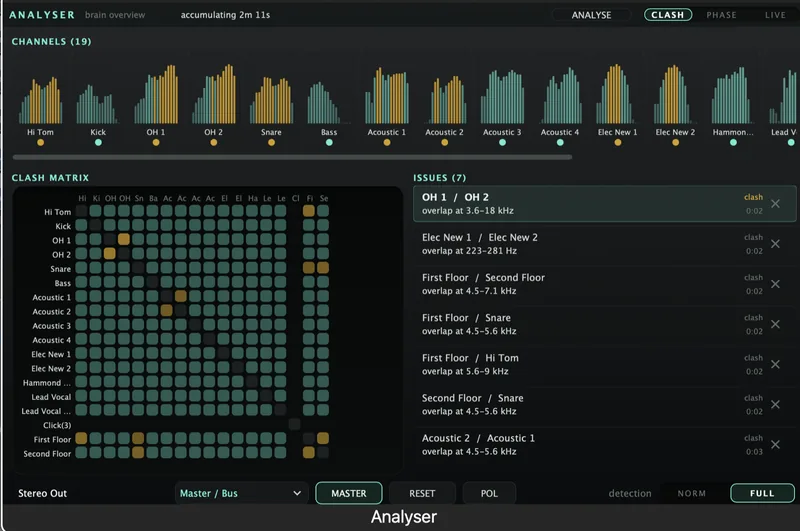
This is a measurement job, not a taste job, which means it can be automated honestly. Analyser sits first on every channel, measures each one during a single playback of the session, and sets the working level for all of them at once.
Common questions
What level should I record at?
Peaks around -12 to -6 dBFS, with the average somewhere near -18. There is no benefit to recording hotter in a 24-bit system: the noise floor is far below anything you will hear, and the headroom protects you from an unexpectedly loud take.
Does gain staging affect sound quality in a DAW?
Not through the summing - a 32-bit float mix bus does not degrade with level. It affects the sound of any plugin that models analogue behaviour, because those have an internal operating point and respond differently to a hot input.
What does -18 dBFS mean?
It is 18 decibels below digital full scale. It matters because most analogue-modelled plugins are calibrated so that -18 dBFS corresponds to 0 VU on the hardware they are based on, which is the level that hardware was designed to run at.
Should I gain stage before or after EQ?
Before. Set a sensible input level first so the EQ, and everything after it, is working in its intended range. If a large EQ boost then pushes the level up, trim it back afterwards rather than changing the level going in.