

guide
What a dynamic EQ is, and when to reach for one
A dynamic EQ is an EQ band whose gain changes with how much signal there is in that band. Below the threshold it does nothing; above it, it cuts or boosts by up to the range you set. That makes it the right tool for a problem that is only present some of the time - a resonance on loud notes, harshness when a singer pushes.
The difference from a static EQ
A static EQ applies the same curve to everything. If you cut 3 dB at 300 Hz, that cut is there on the loud notes where the boxiness is a problem and on the quiet ones where it was holding the body of the sound together.
Most of the time that is what you want, and a static EQ is the simpler, better choice. Reach for a dynamic band only when the problem comes and goes - because a dynamic band that is always active is a static cut with extra steps and more ways to go wrong.
The difference from a multiband compressor
They overlap enough that the distinction sounds pedantic. It still matters. A multiband compressor splits the signal into bands with crossover filters, compresses each one, and sums them back. Those crossovers are always in circuit, they have their own phase behaviour, and the band edges are fixed by the crossover points.
A dynamic EQ does not split anything. It is a normal filter - bell, shelf, whatever shape you chose, with your Q - whose gain is driven by a detector. With the detector idle, the band is flat and out of the way.
- Multiband is for broad, always-on level control across a whole region - glue on a mix bus, taming a bass range.
- Dynamic EQ is for a specific, occasional problem at a specific frequency with a specific shape.
- Overlapping bands are fine on a dynamic EQ and are not possible on a multiband, whose bands are defined by crossovers.
Down is the common case, up is the interesting one
Most dynamic bands turn down when the band gets loud: cut the 300 Hz boxiness only when the singer leans into it, pull the harsh 3 kHz only on the belted notes.
A band that turns up when the band gets quiet is less obvious and often more useful. An acoustic guitar that loses its body during the strummed sections, a vocal whose low mids disappear when the singer backs off, a bass whose fundamental goes missing on the fast passages - all of those are a band gaining upward as the level falls, and none of them are fixable with a static cut.
Setting range and threshold without overthinking
Set the frequency and Q first, with the band in static mode and boosted hard, so you can hear exactly what you are targeting. Then flatten it and switch the dynamics on.
Set the range to the most you would ever want it to move - typically 3 to 6 dB - and then bring the threshold down until the band starts moving on the moments that bother you and stays still the rest of the time. If the meter never rests, the threshold is too low and you have built a static EQ.
Attack and release matter more than they look. Too fast and a band ducking 4 dB on every syllable becomes audible as movement in the tone; too slow and it misses the transient entirely and clamps down afterwards.
Four jobs it does better than anything else
- Resonances that only ring on loud notes - a drum shell, a room mode, a boxy acoustic guitar. - Harshness on peaks - 2-4 kHz on a vocal that is fine until the singer pushes. - Masking between two sources - a band on the guitar that only ducks when the vocal is actually there, keyed from the vocal. - Sibilance - which is a dynamic band at 5-10 kHz. See the de-essing guide for why a dedicated de-esser still does it better.
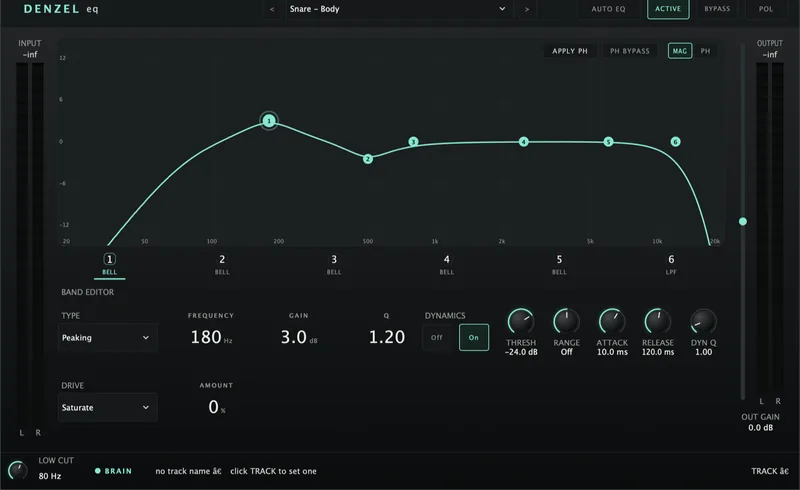
If you want per-band dynamics with saturation on each band as well, that is what Denzel EQ is; if you want one band and two controls, TK Dynamic EQ is the same idea with the decisions already made.
Common questions
What is the difference between a dynamic EQ and a multiband compressor?
A multiband compressor splits the signal with crossover filters and compresses each band separately. A dynamic EQ uses a normal filter whose gain is driven by a detector, with no crossovers and no split - so with the detector idle it is completely out of the way.
Is a de-esser a dynamic EQ?
Functionally yes: a de-esser is a dynamic band in the sibilant range. A dedicated de-esser is still better at it, because its detector is designed to distinguish an ess from a loud vowel rather than just measuring level in the band.
When should I use a static EQ instead?
Whenever the problem is always there. If a cut sounds right on the loud parts and the quiet parts, make it static - it is simpler, it has no detector to mis-set, and there is nothing moving that you have to keep checking.
Does a dynamic EQ cause phase shift?
A minimum-phase dynamic band shifts phase like any analogue-style EQ, and the shift moves as the gain moves. In practice that is inaudible at the 3-6 dB most dynamic bands work over. Linear-phase modes avoid it at the cost of pre-ringing and latency.
Tools for this
Denzel EQ
£29Vintage hardware is loved for its faults - one band gritting up before the rest, drive that leans harder the more you push it, a point where it simply gives up. Denzel lets you design those faults yourself, band by band, and decide whether the damage lands before or after the EQ moves. Then it carries on past anything that could be built: fold a band back on itself dozens of times over, crush it to three bits, aim it at one frequency and leave the rest untouched. Not an emulation of one box - a machine for inventing them.
View plugin →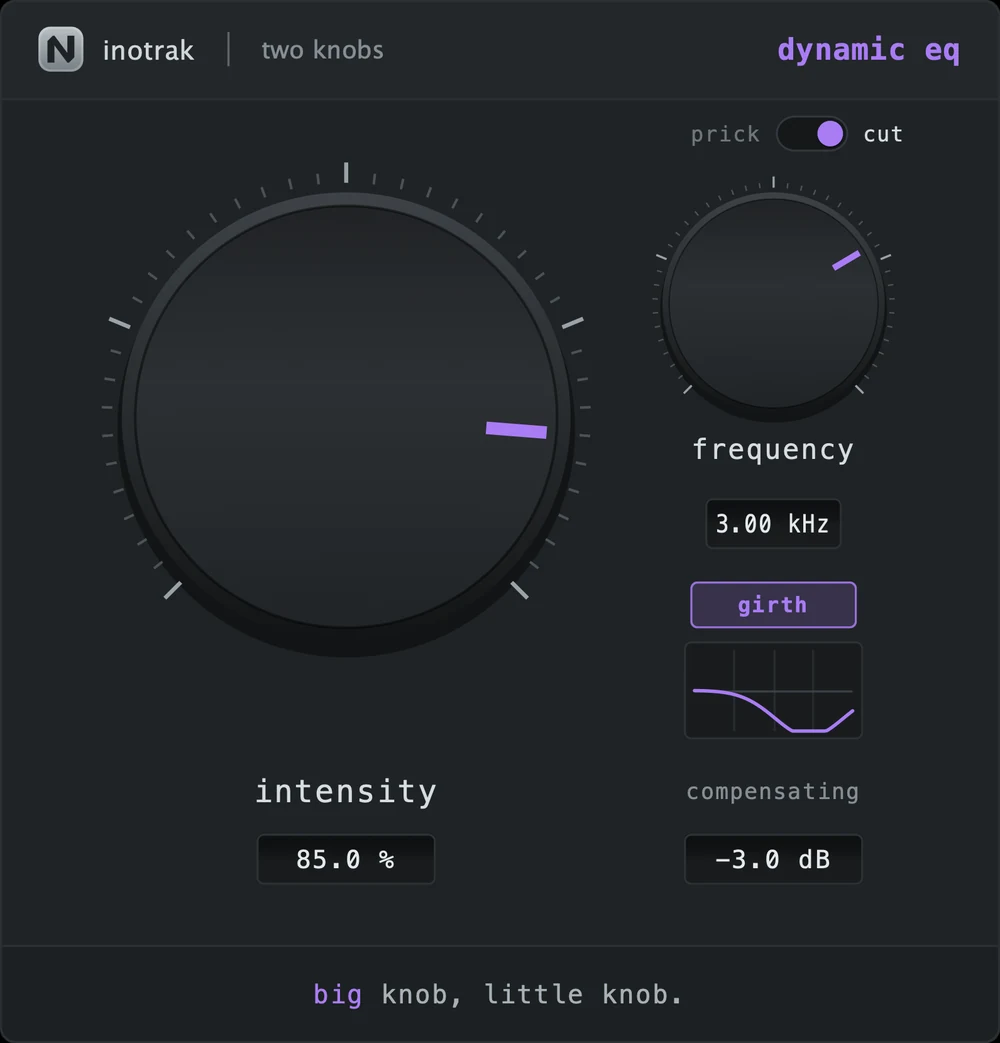
TK Dynamic EQ
£19One dynamic band, reduced to where and how much. Intensity widens the band as it deepens it, so more really is more. Cut a resonance that only shows on loud notes, or lift something that vanishes in the quiet.
View plugin →