

guide
How loud should a master be?
Loud enough that it sounds right. Streaming services normalise playback to around -14 LUFS, so a louder master does not play back louder - it plays back denser. Most commercial releases land between -9 and -6 LUFS integrated. The records I work on usually land between -12 and -8, set by ear rather than to a target.
What LUFS is actually measuring
LUFS - Loudness Units relative to Full Scale - is a measurement of perceived loudness rather than peak level. It applies a frequency weighting that approximates how human hearing responds, so it agrees with your ears far better than a peak meter does. A track peaking at 0 dBFS can measure anywhere from -20 to -5 LUFS depending on how dense it is.
Three numbers get quoted, and they answer different questions:
- Integrated - the whole track, start to finish. This is the number platforms use and the one people mean by "my master is -9".
- Short-term - a rolling three-second window. Useful for seeing how the loudness moves between a verse and a chorus.
- Momentary - a 400 ms window. Useful for catching a single loud moment.
What normalisation actually does
This is the part that is worth understanding properly, because most of the argument about loudness is conducted by people who have it wrong.
Streaming platforms play everything back at a similar loudness so listeners are not reaching for the volume control between tracks. Roughly:
- Spotify targets about -14 LUFS by default, with louder and quieter settings at about -11 and -19.
- Apple Music uses Sound Check, around -16 LUFS.
- YouTube and Tidal sit around -14 LUFS.
Mostly they turn things down. A master at -8 LUFS gets about 6 dB of attenuation on Spotify's default setting and arrives at the listener at the same loudness as a master at -14.
So here is the thing the loudness argument usually misses: on a normalised platform, a louder master does not play louder. What survives the turn-down is not volume, it is everything the limiting did to get there - the density, the sustain, the way the transients sit. That is a sound. It is just not a volume advantage.
And normalisation is not universal. Listeners can switch it off, and it does not apply at all to a download, a CD, a file played from a drive, a DJ set or a sync. Your master outlives the setting.
Why I don't master to -14
This part is opinion rather than fact, and it is mine.
I do not aim at -14 LUFS and I do not think you should either. Music should be mastered to whatever level it sounds good at. People have a volume control, and they know how to use it. If a record wants to be dense and loud, make it dense and loud; if it wants to breathe, let it breathe. Neither decision belongs to a streaming service.
Two things follow from that:
- Most commercially successful music lands louder than -14, and has done for years. A target that almost nothing in the charts meets is not describing the music being made.
- Streaming platforms are a delivery format, and formats come and go. Your record should still sound like your record in twenty years, on whatever people are listening through by then. Mastering to a number that a particular company happens to have chosen in a particular decade is optimising for the most temporary thing in the chain.
The counter-argument deserves stating fairly: if you push a master to -6 LUFS purely to be louder than the next track, normalisation has already taken that away from you, and you have spent your dynamics for nothing. That is true. It is an argument against loudness as a competitive strategy, not against loudness as a sound.
What loudness costs
Getting a master louder means reducing the distance between its peaks and its average level, and there are only so many ways to do that: limiting, clipping, compression, saturation, or arrangement and balance decisions made earlier.
What you spend:
- Transient detail. Drums lose their crack first, and it goes gradually enough that you stop noticing during a long session.
- Depth. Front-to-back separation comes from level differences, and flattening the dynamics flattens that too.
- Room to move. A chorus can only feel bigger than a verse if the verse left somewhere to go.
None of which means do not do it. It means spend it on purpose. Get the loudness from saturation and good balances where you can, and from the limiter where you have to - a distortion stage before a limiter, in the same oversampled path, drives it rather than fighting it, which is the design behind Hodor.
Reference at matched loudness when you decide. Turn the louder version down until the two measure the same and then compare. Almost anything sounds better slightly louder, which is exactly how masters get flattened without anybody choosing it.
True peak is the one number to respect
Whatever loudness you land on, leave headroom in true peak terms.
Digital peak measures sample values. True peak estimates the analogue waveform that those samples reconstruct, which can be higher than any individual sample - and lossy codecs like AAC and MP3 make it higher still, because the decoded signal is not identical to the one that went in. A master sitting at 0.0 dBTP can and does clip after conversion.
Aim for around -1 dBTP. It costs a decibel that normalisation was going to take anyway, and it removes an entire class of distortion that only appears after you have signed the master off.
Where I land
Between -12 and -8 LUFS integrated on most of what I work on, with true peak around -1 dBTP. Not because those are correct numbers - because that is where the material usually sounds right once the decisions above have been made.
Treat that as a description, not a target. If your mix wants to be -14, let it be -14. If it wants to be -7, let it be -7.
Common questions
What LUFS should I master to?
Whatever the music sounds right at. If you want a working range, most modern commercial releases sit between -9 and -6 LUFS integrated, and -12 to -8 is a comfortable place for most material. Aiming at a specific number regardless of the track is the mistake.
Does Spotify turn my master down?
Yes, if it is louder than the target - about -14 LUFS on the default setting. That means a -8 master and a -14 master arrive at the listener at about the same loudness, so pushing for loudness alone gains you nothing there. What carries over is the character of the limiting, not the level.
Is -14 LUFS a rule I have to follow?
No. It is one company's playback setting, it can be switched off by the listener, and it does not apply to downloads, CDs, DJ playback or sync. It is worth knowing about and it is not a specification your master has to meet.
What true peak should I leave?
Around -1 dBTP. Lossy encoding can push the decoded signal above the level your peak meter showed, so a master sitting at 0.0 dBTP may clip once it has been converted to AAC or MP3. One decibel of headroom removes the problem.
Tools for this
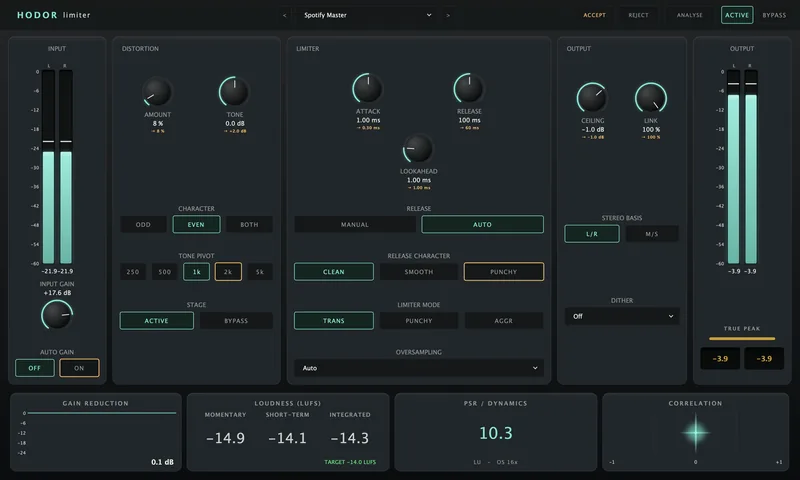
Hodor Limiter
£29Get loud and add harmonic saturation at the same time. The distortion sits before the limiter in the same oversampled path, so it drives the limiter rather than fighting it.
View plugin →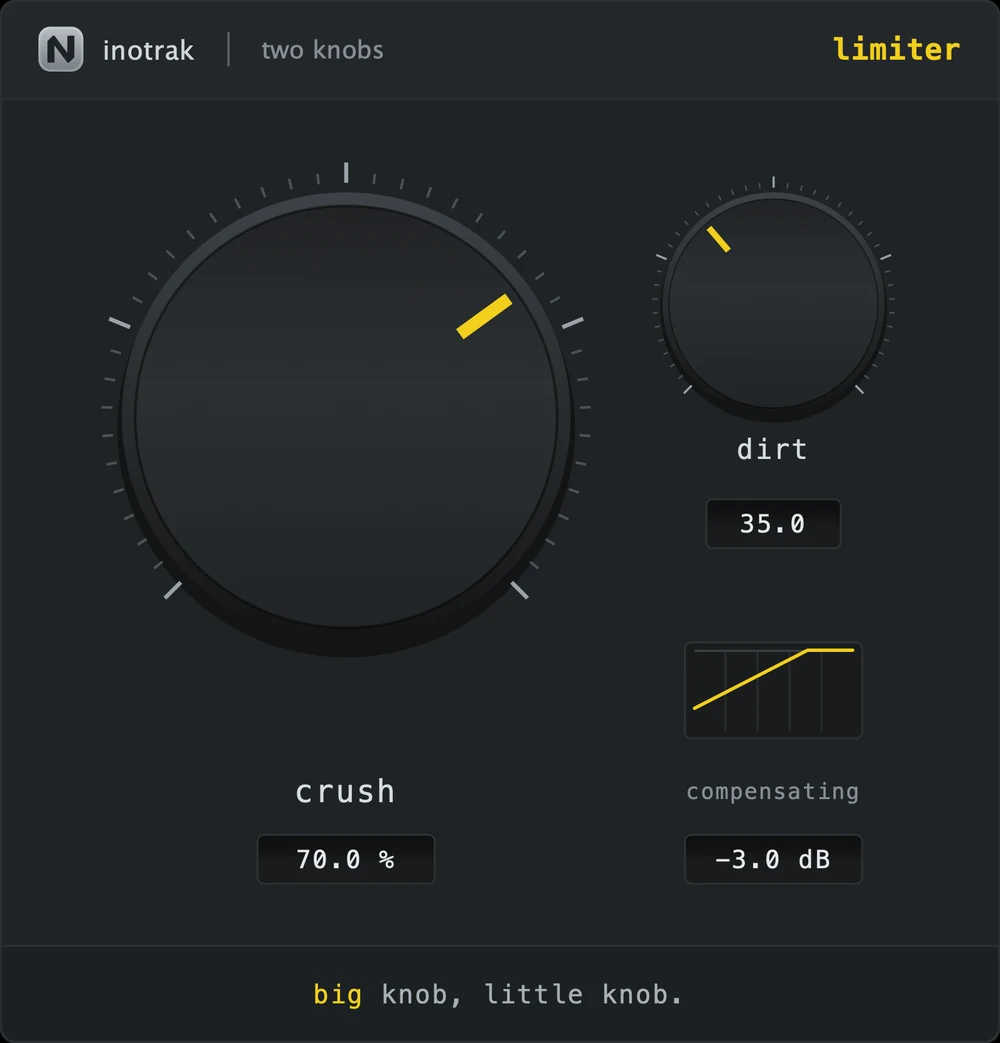
TK Limiter
£19Density on one knob. The ceiling never moves and the output is level-matched to the input, so turning it up cannot make anything louder - only denser. The only honest way to audition a limiter.
View plugin →