guide
Mid/side processing, explained honestly
Mid/side processing converts a stereo pair into mid (what both channels share) and side (what they differ by), processes each separately, and converts back. Mid is L+R, side is L-R. It is a reversible matrix, so with no processing in between, the output is identical to the input.
The whole thing in two lines of arithmetic
Going in: M = (L + R) / 2 and S = (L - R) / 2. Coming back out: L = M + S and R = M - S.
There is nothing more to it. It is not a model of anything, there is no filter involved, and nothing is approximated - which is why an M/S encode followed immediately by a decode gives you back exactly what you put in.
Everything interesting comes from what you do between the two steps.
Why mono compatibility is arithmetic, not a promise
A mono listener hears L + R. Substitute the decode: (M + S) + (M - S) = 2M. The side signal cancels completely.
It settles an argument that comes up constantly. Anything you do to the side channel alone cannot change what a mono listener hears. Boost the side by 12 dB, saturate it, compress it flat, and the mono sum comes out unchanged.
It also tells you where the risk actually is. A width control that turns the side up is mono-safe by construction. One that achieves width with delays, all-pass filters or phase rotation is not, because those change the relationship between L and R rather than the M/S split - and that relationship is exactly what a mono sum is sensitive to.
What it is good for
- Bass in the middle - a high-pass on the side channel only, around 100-150 Hz, puts the low end dead centre while leaving everything above it as wide as it was.
- De-essing the sides - room mics and wide reverbs often carry the sibilance that the centred vocal does not. A de-esser on the side alone leaves the vocal untouched.
- Opening a dense mix - a gentle high shelf on the side adds air without brightening the vocal, which is in the mid.
- Controlling a lead that is too dominant - compressing the mid alone, rather than the whole bus, leaves the room and the reverb breathing.
Where it goes wrong
The one that catches people is over-widening. Turning the side up does not add information - it re-balances what is already there, and past a certain point it hollows out the centre, because the things you wanted (vocal, kick, snare, bass) are all in the mid and everything else is getting louder around them.
The other is M/S on material that is nearly mono. If L and R are almost identical, the side channel is almost nothing - and processing almost nothing, especially compressing or saturating it, amplifies whatever noise and artefacts happen to live there.
Check in mono, and check the side channel on its own. If the side sounds like noise rather than like music, do not process it.
Per-band M/S
Splitting into bands first and then applying M/S per band gets you things a single M/S stage cannot: bass mono, low mids narrowed, top end widened, all at once and independently.
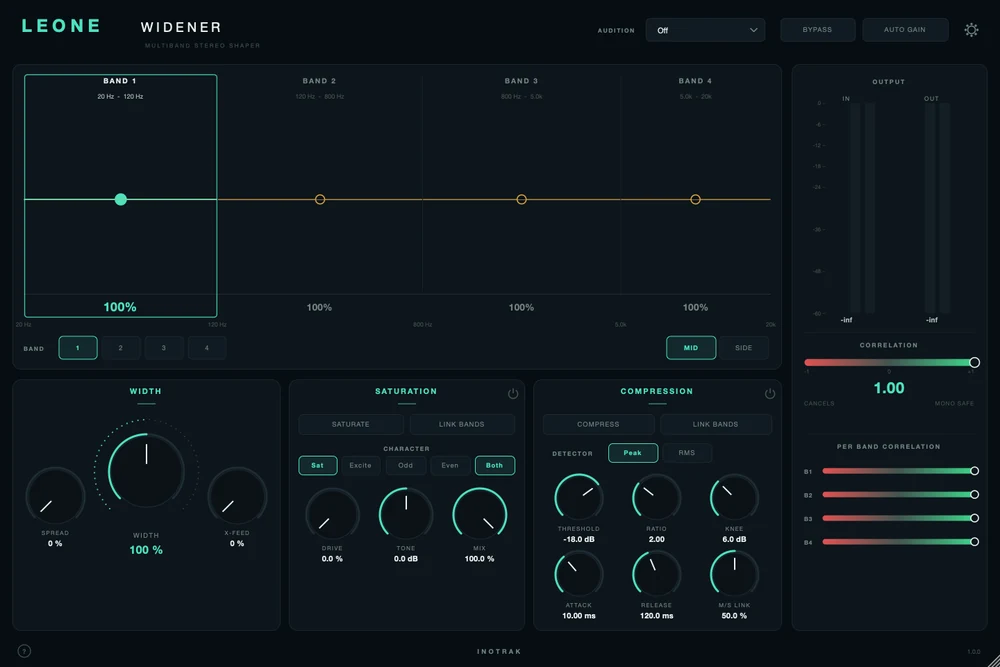
That is the design of Leone Widener - four bands, with a full saturation, compression and tape chain on the mid and the side of each one, and the mono sum untouched by anything on the side by construction rather than by careful setting.
Common questions
Does mid/side processing hurt mono compatibility?
Processing the side channel cannot change the mono sum at all - the side cancels when L and R are added, so the sum is always twice the mid. What does hurt mono compatibility is width created with delays or phase shifts, which is a different technique.
Is mid/side the same as stereo widening?
No. Mid/side is a way of splitting a signal; widening is one thing you can do after splitting it. You can use M/S to make something narrower, to EQ the centre, or to compress the sides, none of which involve width.
Should I use mid/side on the master bus?
Sparingly, and for specific problems - bass that is not centred, a top end that needs air without brightening the vocal. It is not a processing stage every master needs, and small moves are the ones that survive translation.
What is the difference between mid/side and left/right EQ?
Left/right treats the channels as they are. Mid/side treats the centre and the width as separate things. If a problem is centred - a boxy vocal, a woolly bass - M/S lets you fix it without touching the width; L/R does not.