

guide
Phase cancellation, and what actually fixes it
Phase cancellation happens when two signals carrying the same sound arrive at slightly different times, so some frequencies add and others subtract. The first test is the polarity switch: flip one track and listen for which version sounds fuller. If neither does, the problem is timing rather than polarity, and the fix is alignment.
Polarity and phase are not the same control
They get used interchangeably and they are different things.
Polarity is a flip: every sample multiplied by -1. It affects all frequencies equally, it is instant, and it is either on or off. That is what the Ø button does.
Phase is a shift in time, and its effect depends on frequency. A one millisecond offset is a small fraction of a cycle at 50 Hz and several whole cycles at 5 kHz, so the same delay does completely different things across the spectrum.
This matters because it tells you which problems the polarity button can actually solve. A bottom snare mic pointing at the underside of the drum is moving in the opposite direction to the top mic - genuinely inverted - and a polarity flip fixes it completely. Two overheads at different distances are not inverted, they are late, and no polarity flip fixes that.
Where it comes from
Anywhere one sound reaches two inputs by different routes:
- Two mics on one source - top and bottom snare, inside and outside kick, a cabinet with a close mic and a room mic.
- DI and amp - the DI is instant, the mic is however far away plus the amp's own delay.
- A multi-mic kit - every drum arrives at every mic, at a different time for each pair.
- Layered samples - a reinforcement sample landing a few milliseconds off the original hit.
Two mics a foot apart put about a millisecond between them, which is enough to notch out a chunk of the low mids.
What it sounds like
Listen for these, in this order:
- Thin low end. Cancellation eats the fundamentals first, because a small time offset is a large fraction of a cycle down there. A kit that sounds enormous soloed and weedy in the mix is the classic symptom.
- A hollow, filtered quality. Two copies with a fixed delay produce comb filtering - a regular series of peaks and notches across the spectrum, the spacing set by the delay. That is the phasey, flanged sound.
- It collapses in mono. Sum to mono and the cancellation gets worse, because the two signals that were partly separated by panning now add directly. Check in mono. Always.
The fixes, in the order worth trying
1. Move the microphone. Every fix after this one is a compromise, and this one is free while you are still tracking. The 3:1 rule is the usual guide: put the second mic at least three times as far from the first as the first is from the source, so the bleed arrives far enough down in level to stop mattering.
2. Flip the polarity. One click, no side effects, immediately obvious. Do this before anything clever. If it helps, you are done.
3. Align the tracks. Nudge one region until the waveforms line up. This is the right fix for a real time offset, and it is usually a few samples to a few milliseconds. Watch the low end as you do it - that is where the change will be most audible.
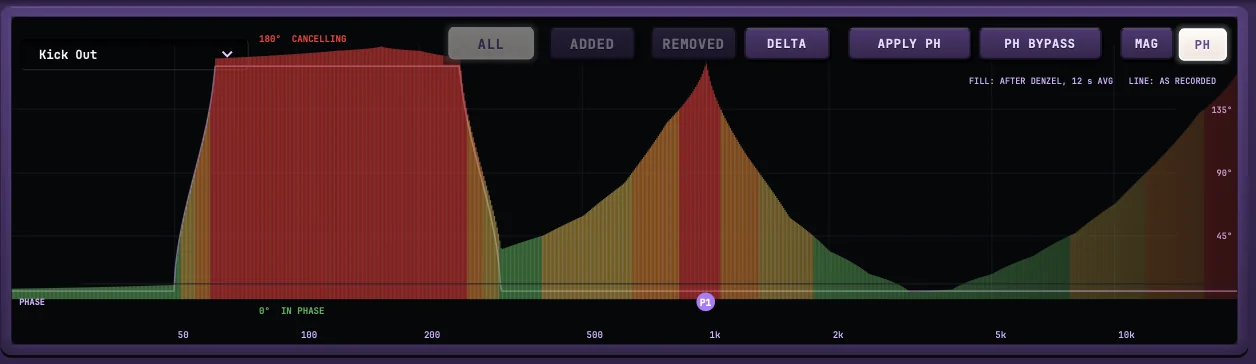
4. All-pass filtering, for what is left. An all-pass rotates phase without touching level, so it can correct differences that are filter-shaped - a mic's own response, a preamp, a cabinet, a crossover - rather than delay-shaped.
Why an all-pass cannot fix a delay
Worth understanding, because it saves you from concluding the tool is broken.
A pure time delay produces a phase difference that rises linearly with frequency and never stops. One millisecond is twenty full rotations across the audio band. An all-pass filter gives you a fixed amount of rotation - a second-order one sweeps 360 degrees in total, and that is all it has.
So no number of all-pass filters fixes a delay. Four will not, and forty would not either. Measured on a pure 0.35 ms offset - about twelve centimetres of mic spacing - four all-pass slots take the average difference from 63 degrees down to 56. Against a difference that is genuinely filter-shaped, the same four slots take 63 degrees to under one.
The lesson is diagnostic rather than defeatist: if phase correction is barely helping, you are holding the wrong tool. Align the tracks first, then use all-pass filtering on the part that is left.
When it is not a problem
Not every phase difference is damage. Two mics on a piano, a room mic behind a kit, a stereo pair on a guitar - the differences between them are what create width and depth. Line everything up perfectly and you get a mono-compatible, lifeless recording.
The test is whether it sounds thin or whether it sounds wide. Thin is a problem. Wide is a recording. If the mono sum survives, leave it alone.
Finding it across a whole session
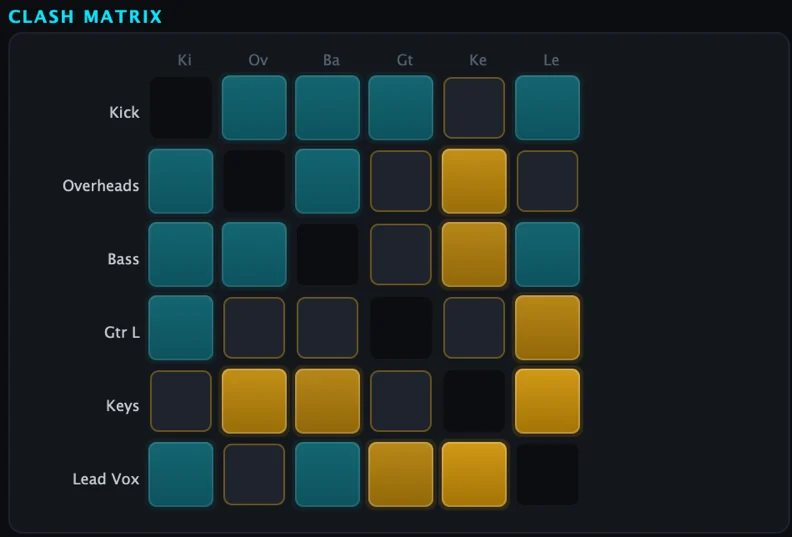
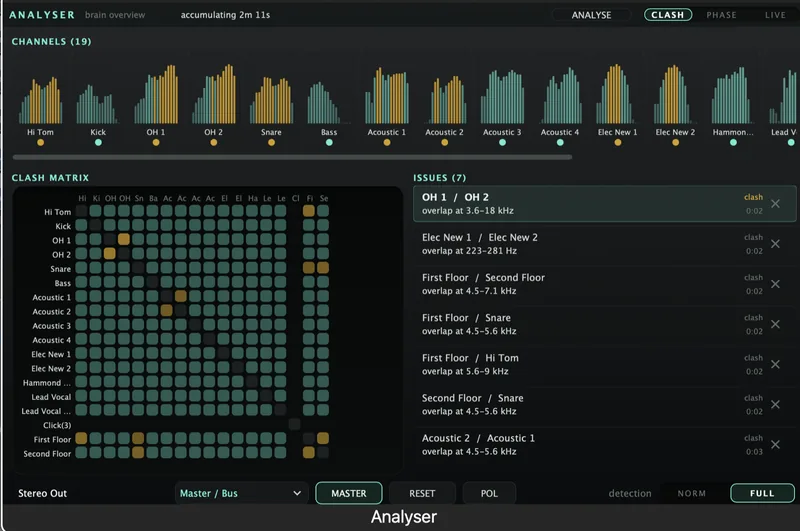
On two tracks this is a manual job. Across nineteen it is not - every pair is a candidate, and the problems are between pairs you would not think to check. That is what Analyser builds its phase and clash matrix for: it measures every pair in the session at once and reports which ones are actually fighting, rather than leaving you to guess. Denzel then carries the all-pass slots for the part that filtering can fix.
Common questions
What is the difference between phase and polarity?
Polarity is an instant flip of the whole signal, affecting every frequency equally - that is the Ø button. Phase is a time shift, so its effect depends on frequency: the same delay is a small fraction of a cycle in the bass and several whole cycles in the treble.
How do I check for phase problems?
Sum to mono and listen to the low end. Cancellation gets worse in mono because signals that panning had partly separated now add directly. Then flip the polarity of one track and compare - whichever version sounds fuller is the right one.
Does flipping polarity always fix phase cancellation?
No. It fixes genuine inversions - a bottom snare mic, a mic behind a cabinet - completely. It does nothing for a time offset between two mics at different distances, which needs the tracks aligning rather than flipping.
Why does my drum kit sound thin in the mix but fine soloed?
Almost always cancellation between the close mics and the overheads. Soloed, each mic sounds complete; together, the low end partly subtracts. Check in mono, flip the polarity of each close mic in turn, then align if flipping does not do it.
Tools for this
Analyser
£29Builds a phase- and frequency-clash matrix of your entire mix, then tells every EQ how to fix it. Sets levels across the whole session in ten seconds. Live mode for setting up studio mics while you move them.
View plugin →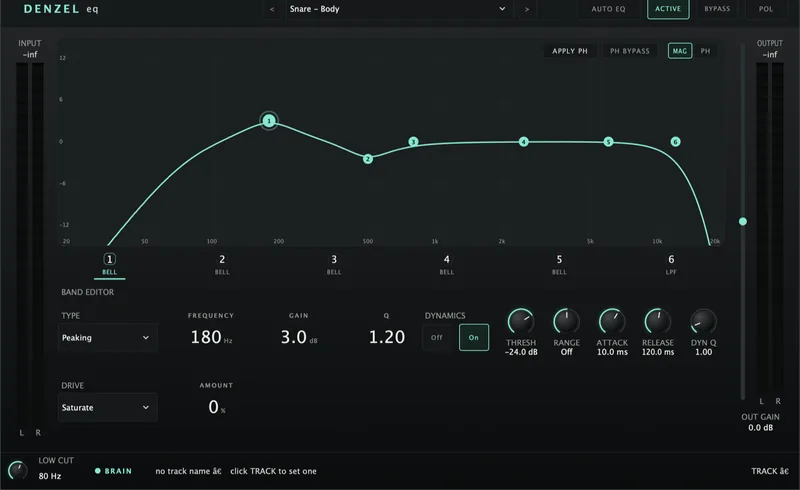
Denzel EQ
£29Vintage hardware is loved for its faults - one band gritting up before the rest, drive that leans harder the more you push it, a point where it simply gives up. Denzel lets you design those faults yourself, band by band, and decide whether the damage lands before or after the EQ moves. Then it carries on past anything that could be built: fold a band back on itself dozens of times over, crush it to three bits, aim it at one frequency and leave the rest untouched. Not an emulation of one box - a machine for inventing them.
View plugin →