

guide
What order should a vocal chain go in?
There is no single correct order, but there is a default that works: corrective EQ, de-esser, compressor, tonal EQ, saturation, then effects on sends rather than inserts. The principle underneath it is to remove problems before anything amplifies them, and to put the things that react to level before the things that add it.
The default, and the reasoning
1. Gain - set a sensible working level first, so everything downstream sees what it expects. See gain staging. 2. Corrective EQ - high-pass, and cut the specific problems: a boxy resonance, a rumble, a proximity build-up. 3. De-esser - take the peak off the sibilance before anything reacts to it or multiplies it. 4. Compressor - level the performance now that it is free of the things that would trigger it wrongly. 5. Tonal EQ - shape the sound you want, on a signal whose level is now stable. 6. Saturation - add harmonics and density last in the channel, where the level feeding it is predictable. 7. Effects on sends - reverb and delay fed from the finished channel.
Read it as one rule: subtract, control, then add.
Clean before colour
The reason corrective EQ goes first is that everything after it reacts to what you feed it. A 200 Hz build-up left in place will pull the compressor down on every low note, so the compressor ends up working on a problem rather than on the performance. Remove it first and the compressor does the job you actually wanted.
The same logic puts tonal EQ after the compressor. If you boost 10 kHz before a compressor, the compressor sees more high-frequency energy and reduces gain harder on bright syllables - so the boost partly fights itself. After the compressor, a boost is a boost.
Most vocals want both, and that is normal: a cut before, a boost after. Two EQs doing different jobs is not redundancy.
De-essing goes early, and sometimes twice
Before the compressor, always. An untamed ess will trigger a compressor and duck the whole word around it, which reads as pumping on the consonants.
Before saturation, always. Saturation generates new high-frequency content out of whatever you feed it, so a loud ess going in comes out louder and wider. De-essing afterwards means fighting something you just made.
A second, gentler de-esser at the end of the chain is often worth it, to catch what the tonal EQ and the saturation added. Two shallow passes in different places almost always sound better than one deep one - the full reasoning is in the de-essing guide.
One compressor or two
Two gentle stages usually beat one heavy one.
A single compressor asked to do 10 dB of reduction has to be set aggressively enough that you hear it working. Split across two - say 4 dB from a fast one catching peaks, then 3 dB from a slower one levelling the performance - and each stage stays comfortable while the total control is greater.
The two want different settings, because they are doing different jobs:
- First - faster attack, catching the peaks that stick out.
- Second - slower attack and release, riding the overall level of the performance the way a fader would.
If you would rather do it with one, that is fine too, and the settings matter more than the count - see attack and release.
Effects belong on sends
Reverb and delay go on a send, not as inserts on the vocal channel, for two reasons.
You can process the effect separately. High-passing a reverb return, de-essing it, or compressing it independently of the dry vocal are all things you cannot do when the effect is inline. Sibilance and low mids are exactly what makes a reverb sound cheap, and the send is where you fix that.
And you can feed several sources into one space. A vocal and its doubles sharing a reverb sound like they are in the same room; three separate inserts sound like three rooms.
Four places to break the order
The default is a starting point, not a rule. The useful exceptions:
- Saturation first, as the tone of the channel rather than the finish - standing in for a console preamp. Then the rest of the chain follows it, the way it would have on a desk.
- Compressor before corrective EQ, when the performance is so uneven that you cannot hear the problems clearly enough to cut them. Level it first, then listen again.
- De-esser after compression only, when the compressor is doing so little that the sibilance never triggers it - rare, but it happens on a controlled singer.
- Dynamic EQ instead of a cut, when the problem is only there sometimes. A vocal that gets harsh at 3 kHz only when the singer pushes does not want a static cut that dulls the quiet lines - that is a dynamic band's job.
The order matters less than the amounts
Worth saying plainly at the end: chain order is a real thing and it is not the main thing. A well-chosen 2 dB cut in the wrong position beats a badly chosen 6 dB cut in the right one.
If a vocal is not sitting, the answer is much more often the amount of compression, the choice of frequency, or the performance itself than it is the running order. Get the default order in place, stop thinking about it, and spend the attention on the settings.
Common questions
Should EQ go before or after compression?
Both, doing different jobs. Corrective cuts go before, so the compressor is not reacting to a problem you are about to remove. Tonal boosts go after, because a boost before the compressor makes it reduce gain harder on exactly the frequencies you just lifted.
Do I need two compressors on a vocal?
You do not need two, but two gentle stages usually sound better than one heavy one. A fast compressor catching peaks followed by a slower one riding the overall level gives more control than either alone, with each doing less work and staying less audible.
Where does saturation go in a vocal chain?
Late in the channel, after the compressor, where the level feeding it is predictable - saturation is level-dependent, so an uneven signal gets uneven colour. The exception is using saturation first as a preamp stage, which is a tone decision rather than a finishing one.
Should reverb be an insert or a send?
A send, in almost every case. It lets you EQ, de-ess and compress the reverb independently of the dry vocal, and it lets several sources share one space so they sound like they are in the same room.
Tools for this
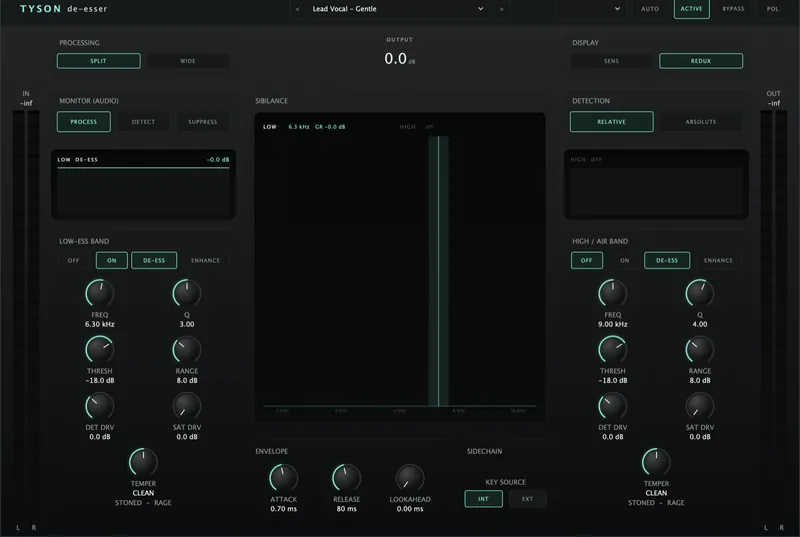
Tyson De-Esser
£29De-esses without the lisp, and runs backwards too - putting an ess back when a vocal has gone soft. Saturation from smooth to savage.
View plugin →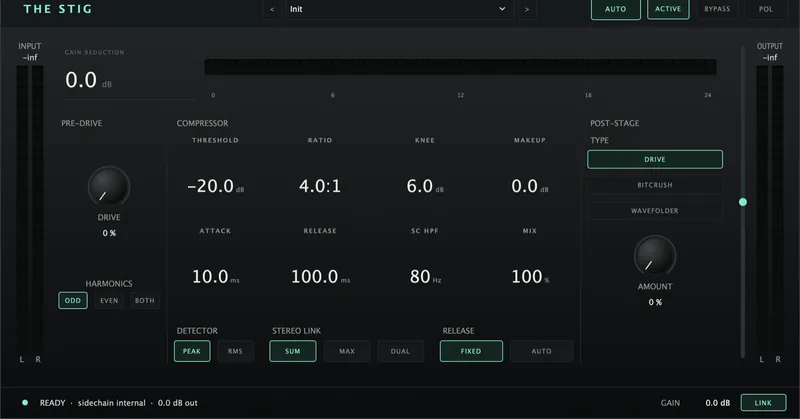
The Stig Compressor
£29A compressor that saturates hard and distorts harder. The drive hits the detector, not just the tone - so it changes how it grabs, not only how it sounds.
View plugin →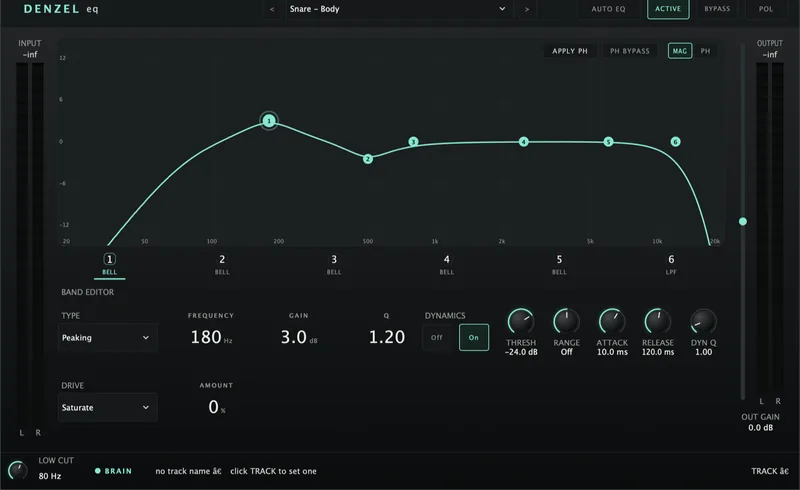
Denzel EQ
£29Vintage hardware is loved for its faults - one band gritting up before the rest, drive that leans harder the more you push it, a point where it simply gives up. Denzel lets you design those faults yourself, band by band, and decide whether the damage lands before or after the EQ moves. Then it carries on past anything that could be built: fold a band back on itself dozens of times over, crush it to three bits, aim it at one frequency and leave the rest untouched. Not an emulation of one box - a machine for inventing them.
View plugin →