guide
Reverb settings, and which ones actually matter
Three controls do most of the work. Pre-delay sets the gap between the dry sound and the first reflections, and it is what keeps a vocal clear while still putting it in a space. Decay sets how long the tail lasts, and wants to follow the tempo. High-cut on the return is what stops the reverb competing with the source.
Pre-delay is the clarity control
If a reverb is making something sound distant or smeared, this is the setting to reach for first.
Pre-delay is the gap between the dry signal and the onset of the reverb. With none, the tail starts on top of the word and blurs it. With 20 to 40 milliseconds, the word arrives dry and intelligible, and the space opens up behind it. The vocal stays forward and still sounds like it is somewhere.
It also carries real information. In a physical room, the delay before the first reflections tells you how far the walls are - a short pre-delay means a small space, a long one means a large one. So you can use it to suggest room size independently of how long the tail runs.
Rough starting points:
- 0-10 ms - the source sits inside the space. Good on drums where you want the room to be part of the hit.
- 20-40 ms - the standard vocal setting. Clear, still in a room.
- 60-120 ms - the reverb reads as a separate event. Gets close to being an effect rather than a space.
Setting it to a note value is worth trying - an eighth or sixteenth at the track's tempo - so the reverb onset lands with the music rather than against it.
Decay, and the tempo
Decay time is how long the tail takes to fall away. The useful rule: it should be gone before the next important thing arrives.
At 120 bpm a bar is two seconds. A three-second tail is still sounding through the next two chord changes, which is how a mix turns to soup. Something between one and two seconds usually sits well on a mid-tempo track; faster tracks want shorter.
Two practical habits:
- Check the decay against the busiest part of the arrangement, not the sparse intro. A tail that sounds beautiful under a solo vocal will be mud under a full band.
- Mute the dry signal and listen to the return alone occasionally. It should sound like a space, not like a distinct musical event. If you can hum the reverb, it is too long or too resonant.
EQ the return, not the source
The single biggest improvement most reverbs can get, and the reason they belong on a send rather than an insert.
- High-cut around 6-10 kHz. Real rooms absorb high frequencies as sound travels, so an untamed bright tail sounds artificial as well as competing directly with the source's own presence. This one change is usually the difference between a cheap reverb and an expensive-sounding one.
- Low-cut around 200-400 Hz. Low frequencies in a tail pile up fast and eat the space the bass and kick need. There is almost never a reason for a vocal reverb to carry much below 300 Hz.
- De-ess the return. Sibilance going into a reverb comes back as a hissy cloud that sustains for the length of the tail. A de-esser on the send fixes it without touching the dry vocal - see the de-essing guide.
Plate, room, hall - what the labels mean
- Plate - no early reflections and a dense tail from the moment it starts. Bright, smooth, and it does not suggest a physical room. The default for vocals and snares for exactly that reason: it adds sustain and sheen without moving the source anywhere.
- Room - short, with audible early reflections. Adds space and a sense of place without much tail. Good on drums and on anything that needs to sound recorded rather than dry.
- Hall - long, with a noticeable gap before a slow, diffuse build. Spacious and obvious. Use sparingly and with plenty of pre-delay.
These are tunings rather than categories, and the labels matter far less than the three settings above.
Short reverb as a tone, not a space
A reverb under about 400 ms stops reading as a room and starts reading as part of the sound. A very short, bright plate on a snare thickens the hit; a tight room on a close-miked guitar makes it sound recorded rather than plugged in.
Worth trying whenever something sounds sterile but you do not want it to sound distant. You are using the reverb as a texture, and the usual advice about decay and tempo does not really apply.
Designing the faults in
A real space is not a clean one. Rooms have resonances, surfaces that absorb unevenly, and corners that ring at particular frequencies - and those imperfections are most of what makes a space sound like somewhere rather than like a plugin.
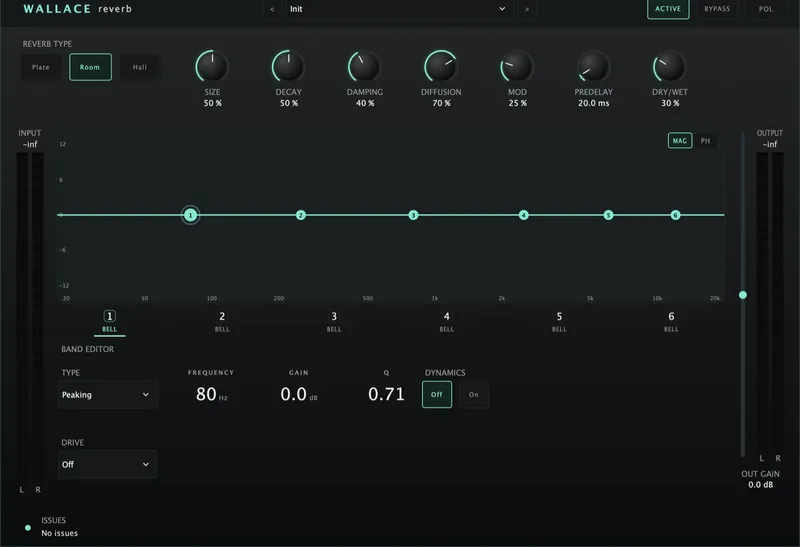
That is what Wallace is built around: the same per-band EQ and distortion engine as Denzel, running on the tail alone. A band can grit up before the rest, the drive can lean harder the more you push it, and the dry signal never moves however far you push the wet.
Common questions
What is pre-delay in reverb?
The gap between the dry sound and the start of the reverb tail. It keeps the source intelligible by letting the word or hit arrive before the space opens up behind it. Around 20-40 ms is the standard vocal setting.
How long should a reverb tail be?
Short enough that it has gone before the next important event. At 120 bpm that usually means one to two seconds. Check it against the busiest part of the arrangement rather than the sparsest, because that is where a long tail causes problems.
Why does my reverb sound cheap?
Most often an untamed high end. Real rooms absorb high frequencies as sound travels, so a bright tail sounds artificial and competes with the source. High-cut the return around 6-10 kHz, low-cut it around 300 Hz, and de-ess it.
Should reverb go on a send or an insert?
A send, in almost every case. It lets you EQ, de-ess and compress the reverb independently of the dry signal, and it lets several sources share one space so they sound like they are in the same room rather than three different ones.