

guide
Saturation, distortion and what they actually do
Saturation and distortion are the same process at different intensities: a non-linearity that adds harmonics not present in the original. Saturation is gentle enough that the waveform stays recognisable; distortion is the same thing pushed until the shape is visibly altered. Which harmonics get added matters more than which word you use.
One process, a sliding scale
Put a sine wave through anything non-linear and you get the original frequency plus multiples of it - harmonics. How many, how loud and which ones depends on the shape of the non-linearity and how hard you drive it.
At low drive the output is nearly a copy of the input with a few quiet harmonics on top. Push harder and the harmonics grow, the peaks round off, and the waveform starts to resemble a square wave. There is no line in the sand where saturation becomes distortion; there is a continuum, and the words describe roughly where you are on it.
That is why the same plugin can be a subtle thickener and an obvious effect depending on one knob.
Even and odd - the part that matters
This is the distinction worth carrying around.
- Even harmonics (2nd, 4th) are octaves and octave-plus-fifths of the fundamental. They are consonant with the note, so they read as fuller, warmer, bigger - the sound thickens without obviously dirtying.
- Odd harmonics (3rd, 5th) are fifths and thirds above the octaves. They read as harder, edgier, more aggressive - the sound gets more present and more obviously processed.
What produces which comes down to symmetry. An asymmetric non-linearity - one that treats the positive and negative halves of the waveform differently - generates even harmonics. A symmetric one generates odd harmonics only. In circuit terms, single-ended stages lean even and push-pull stages lean odd, which is a large part of why two pieces of equipment with similar specifications sound nothing alike.
Practically: reach for even when something needs weight and body, odd when it needs to cut through.
Level decides everything
Saturation is level-dependent, and this trips people up constantly.
A non-linearity only does anything to the parts of the signal that reach it. A track sitting at -30 dBFS barely touches a stage designed to round off near unity, so the plugin appears to be doing nothing and the temptation is to turn the drive up until it does - by which point the loud passages are being mangled.
Two consequences:
- Set the input level first. A saturator's character changes with what you feed it, so gain staging is not housekeeping here, it is part of the sound. See the gain staging guide.
- Quiet passages get less of it, automatically. That is usually a feature - the effect follows the performance - but it means a verse and a chorus can come out differently coloured.
The exception is anything with a fixed threshold rather than a soft knee near unity: bitcrushing and hard clipping do not care how quiet the signal is, and stay just as audible.
The types, and what each one is for
- Tape - gentle compression with the saturation, softened transients, a slight high-frequency roll-off. Good for glue and for taking the edge off something brittle.
- Tube - asymmetric, so even-harmonic and warm. Good for adding body to thin sources.
- Transformer - saturates in the low end first, because core saturation follows energy and the bass carries most of it. Good for making a kick or a bass feel solid.
- Transistor / solid-state - harder, odd-leaning. Good for cutting through.
- Digital clipping - no curve at all, just a ceiling. Harsh, efficient, and the loudest way to gain a couple of dB before a limiter.
- Wavefolding - instead of flattening at the ceiling, the waveform folds back on itself. Generates dense harmonics that are not simple multiples, so it sounds metallic and inharmonic rather than warm. An effect rather than a finish.
- Bitcrushing - quantisation error rather than waveform shaping. Its artefacts have no linear component at all, which is why it sounds like nothing else on this list and why it stays audible at any level.
Using it for loudness
Saturation is a loudness tool as much as a tone one, and it is a gentler one than a limiter.
Rounding the peaks reduces the distance between peak and average level, which means the track can sit louder before anything else has to intervene. Do that across several channels in small amounts and the mix arrives at the limiter already dense, so the limiter has less to do - see how loud a master should be.
A distortion stage placed before a limiter in the same oversampled path drives the limiter rather than fighting it. Put it after and you are distorting something that has already been peak-controlled, which undoes the control.
Where it goes
Late in a channel, after compression, where the level feeding it is predictable - an uneven signal gets uneven colour.
The exception is using saturation as the input stage, standing in for a console preamp, in which case it goes first and everything downstream inherits it. Both are valid; what does not work is putting it somewhere arbitrary in the middle and wondering why it behaves differently every time the arrangement changes.
One caution worth repeating: saturation creates new high-frequency content. On a vocal that means sibilance you already tamed can come back louder and wider, so de-ess before it rather than after - the de-essing guide has the detail.
Common questions
What is the difference between saturation and distortion?
Intensity, not mechanism. Both add harmonics through a non-linearity. Saturation is gentle enough that the waveform stays recognisable and the effect reads as warmth or weight; distortion is the same process pushed until the shape is altered and the effect is obvious.
What is the difference between even and odd harmonics?
Even harmonics are octaves and octave-plus-fifths, consonant with the note, so they sound fuller and warmer. Odd harmonics are fifths and thirds above, so they sound harder and edgier. Asymmetric circuits produce even harmonics, symmetric ones produce odd.
Why can't I hear my saturation plugin doing anything?
Probably because the signal is too quiet to reach the non-linearity. Saturation is level-dependent, so a track at -30 dBFS barely engages a stage designed to round off near unity. Raise the input level rather than the drive amount.
Should saturation go before or after compression?
After, in most cases, because a compressed signal has a predictable level and therefore gets consistent colour. The exception is using it as a preamp stage at the top of the channel, which is a deliberate tone choice rather than a finishing one.
Tools for this
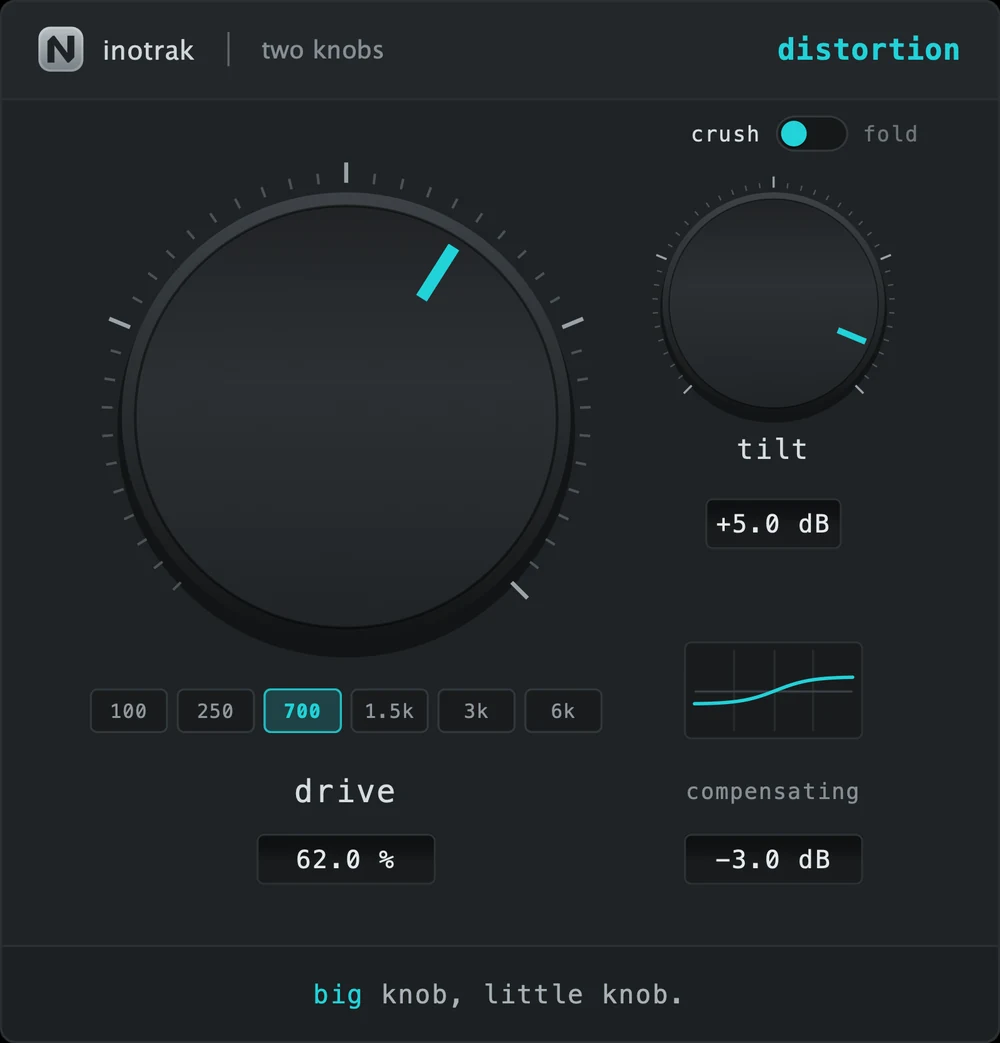
TK Distortion
£19One knob that walks through five distortion characters as it climbs - clean, odd, even, both, then digital - crossfading so the tone morphs rather than switches. It gets weirder as it goes up, not just dirtier.
View plugin →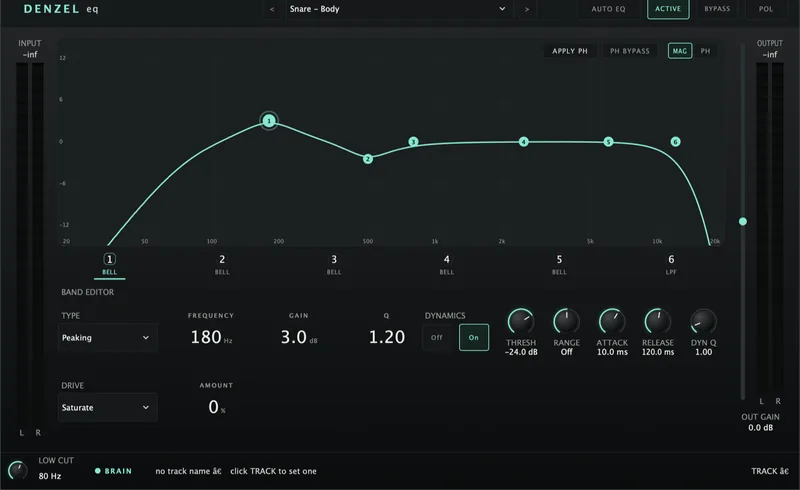
Denzel EQ
£29Vintage hardware is loved for its faults - one band gritting up before the rest, drive that leans harder the more you push it, a point where it simply gives up. Denzel lets you design those faults yourself, band by band, and decide whether the damage lands before or after the EQ moves. Then it carries on past anything that could be built: fold a band back on itself dozens of times over, crush it to three bits, aim it at one frequency and leave the rest untouched. Not an emulation of one box - a machine for inventing them.
View plugin →