guide
Making a DI'd acoustic guitar sound like a mic'd one
A DI'd acoustic sounds thin and quacky because an undersaddle pickup measures string pressure at the bridge rather than the sound the body makes. The fix is in three parts: cut the quack between 2 and 5 kHz, restore the body resonance around 100-200 Hz, and add the harmonic content a pressure sensor never captured.
Why it sounds like that
An undersaddle transducer is a piezo strip under the bridge saddle. It responds to the pressure the strings exert on it - which correlates with what you play, but is not the sound of the guitar.
What it misses:
- The body. An acoustic guitar is a resonant box with a strong air resonance somewhere around 90-110 Hz, and a soundboard that radiates the whole low midrange. The pickup is clamped under the saddle and hears almost none of it, which is why a DI sounds small even when the guitar is huge in the room.
- The air. The top end of a mic'd acoustic comes partly from the room and from how the instrument radiates high frequencies into it. A contact sensor has no room.
- The distance. Every microphone position averages the instrument over some distance. A pickup is a point measurement, so nothing is averaged and any local quirk is reproduced at full strength.
And what it adds: a pronounced peak in the 2-5 kHz region, which is the "quack" - the brittle, plasticky attack that makes a DI recognisable as a DI within one strum.
The three moves, in order
1. High-pass, but not far. There is usually rumble and handling noise below 50 Hz that carries no music. Roll off around 50-70 Hz. Go higher and you start removing the little genuine low end the pickup did capture.
2. Cut the quack. Sweep a moderately narrow band - Q around 2 to 4 - between 2 and 5 kHz until you find the frequency that makes the guitar sound like a plastic toy, then cut it by 3 to 8 dB. Every pickup and guitar sits at a slightly different frequency, so find it rather than assuming one.
Worth knowing: the quack is often worse on hard strums than on fingerpicking, because it comes from the attack transient. If a static cut dulls the quiet passages while only just controlling the loud ones, that is a dynamic EQ problem - one band, around 3 kHz, acting only when you dig in.
3. Put the body back. A gentle boost somewhere between 100 and 200 Hz restores the weight the pickup missed. Be careful here - too much, too wide, and you get boom rather than body, and it will disappear the moment a bass guitar arrives. A dB or two on a moderate Q usually does more than you expect.
What EQ alone cannot do
At some point you run into a real limit: EQ can only change the level of frequencies that are already there.
A mic'd acoustic is rich in harmonic content that a pressure sensor at the bridge simply never generated. You can boost 5 kHz all you like; if there is nothing musical at 5 kHz to boost, you get noise and quack rather than air.
So the last move is not EQ, it is generating the missing content - saturation, which produces harmonics related to what is already present rather than amplifying what is not. A small amount, aimed at specific bands rather than the whole signal, adds the complexity a DI lacks without making the guitar sound distorted. The saturation guide covers why even and odd harmonics do different jobs here - even for body, odd for presence.
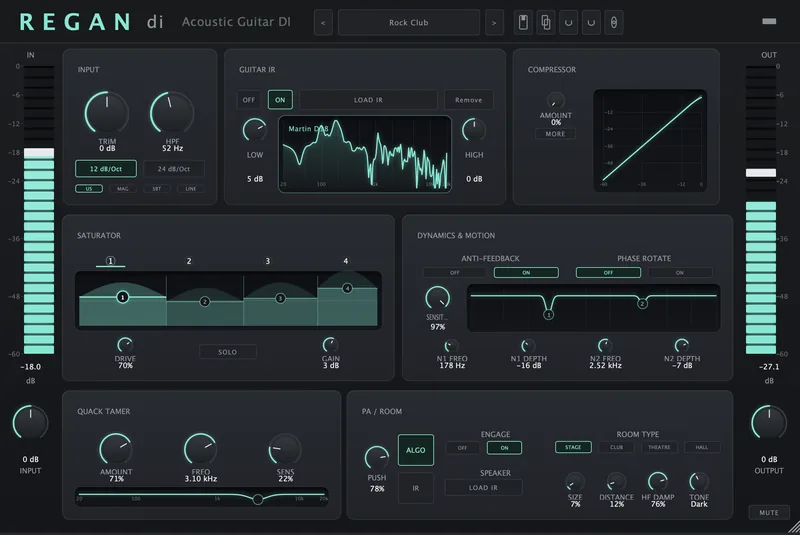
Doing it per band matters. Broadband saturation on an acoustic thickens the low mids you just carefully shaped and brings the quack back up with everything else. That targeting is what DI Regan is built around - a four-band saturator plus the EQ moves above, for exactly this one job.
Blending a mic with the DI
If you have both, blending is the best-sounding option available - and it comes with a warning.
The mic is further from the strings than the pickup, so the two signals arrive at different times. Sum them and you get comb filtering: a hollow, phasey quality and a low end that partly cancels. It can be worse than either source alone.
Three things, in order:
1. Flip the polarity of one and keep whichever sounds fuller. Free, instant, and sometimes the whole fix. 2. Align the tracks. Nudge the mic track earlier until the waveforms line up. This is the real fix for a distance offset. 3. Check in mono. Cancellation is always worse in mono, and that is where half your listeners are.
The phase guide has the detail, including why an all-pass filter cannot fix a plain distance offset.
Compression, lightly
An acoustic has a wide dynamic range and a strong transient on every strum, so some compression usually helps it sit. Keep it gentle - 2 to 4 dB, a medium attack around 15-30 ms so the pick attack survives, and a release that recovers between strums.
Heavy compression on an acoustic pulls up string squeak, body thumps and the noise floor of the pickup, all of which were quiet for a reason.
When a DI is the right choice anyway
Worth saying, because the framing so far has been "make it sound like a mic":
- Live and loud. A mic on stage picks up the whole band. A DI does not.
- When the player moves. A mic's tone changes as the guitarist shifts; a pickup's does not.
- Consistency across takes. Comping four takes recorded with a mic means four slightly different tones and positions. A DI is identical every time.
- When the part is rhythmic rather than featured. A DI's sharper attack and smaller body can sit in a dense mix more easily than a full mic'd sound, which has to be carved out of the middle of the arrangement.
Common questions
Why does my acoustic guitar DI sound thin and quacky?
Because an undersaddle pickup measures string pressure at the bridge rather than the sound of the body. It misses the air resonance around 90-110 Hz that gives an acoustic its weight, and adds a peak somewhere between 2 and 5 kHz that reads as brittle and plasticky.
What frequencies should I EQ on a DI acoustic?
High-pass around 50-70 Hz, find and cut the quack between 2 and 5 kHz by 3 to 8 dB, and add a small boost between 100 and 200 Hz to restore body. Sweep to find the quack rather than assuming a frequency - it moves with the guitar and the pickup.
Can you make a piezo pickup sound like a microphone?
Not identically, but much closer than most people get. EQ fixes the balance; the part EQ cannot do is supply harmonic content that was never captured, which needs saturation to generate rather than a boost to amplify.
Should I blend a microphone with the DI?
If you can, yes - it usually beats either alone. Check the polarity first and align the two tracks, because the mic is further from the strings and the time offset will comb-filter the low end. Always check the blend in mono.