

guide
What order should guitar pedals go in?
The usual order is tuner, filter, compressor, dirt, modulation, then delay and reverb last. The principle underneath it: each pedal processes whatever the one before it produced, so anything that shapes the tone goes before anything that repeats or smears it. Put a delay in front of a distorting amp and you distort the repeats.
The standard order
1. Tuner - first, so it sees the raw signal and mutes everything. 2. Filter and wah - a wah sweeps a resonant peak, and it wants the guitar's own signal to sweep rather than something already squashed. 3. Compressor - levels the playing before anything reacts to it. 4. Dirt - overdrive, distortion, fuzz. Usually stacked lowest-gain first. 5. Modulation - chorus, phaser, flanger, tremolo. 6. Volume pedal - position depends on what you want it to do, see below. 7. Delay, then reverb - last, so they repeat the finished sound.
Read it as one rule: shape the tone, then repeat it. Almost every position in the list follows from that.
Why delay and reverb go last
This is the one that makes the whole thing click.
A delay in front of a distorting amp sends its repeats into the distortion. Each repeat gets compressed and saturated along with the dry note, so instead of the note repeating and fading, you get a wash where the quiet repeats have been pushed back up to nearly the same level as the original. It sounds muddy and indistinct, and no amount of adjusting the delay fixes it, because the problem is the amp.
Put the delay after the distortion and each repeat is a copy of the distorted sound, decaying cleanly. That is what a delay is supposed to do.
On real amps this is what the effects loop is for: it sits after the preamp distortion and before the power stage, so time-based effects land in the right place while everything else stays out front.
Compressor before or after dirt
Both are used, and they do genuinely different things.
Before the dirt, the compressor levels your playing, so the distortion is driven consistently whether you pick hard or soft. Sustain increases and the dynamics of your right hand matter less. This is the country and pop setting.
After the dirt, the compressor levels the distorted output. The picking dynamics still reach the drive pedal, so quiet playing stays clean and hard playing bites - and the compressor just evens out the result.
If you want the amp to respond to your hands, put it after. If you want consistency, put it before.
Fuzz goes first, and there is a reason
Classic fuzz circuits, especially germanium ones, interact directly with the guitar's pickups - their input impedance is low enough that the pickup and the pedal effectively become one circuit. That interaction is part of the sound.
Put a buffered pedal in front of one and it no longer sees the pickups, it sees the buffer's output, and the fuzz loses the ragged cleanup that made it worth having. A wah before a fuzz has the same effect and is the classic case of a break-the-rules combination that works for exactly that reason.
So: fuzz first, before any buffered pedal, and before the wah unless you specifically like what a wah-into-fuzz does.
Volume pedal, and what it controls
Before the dirt, rolling back the volume reduces how hard the drive pedal is driven, so you get cleaner and quieter - the same thing that happens when you roll back the guitar's volume knob.
After the dirt, it changes level only. The distortion stays exactly as dirty and just gets quieter, which is what you want for volume swells and for riding level during a song.
Noise gates
After the dirt, because that is what is generating the noise. A gate in front of a distortion pedal is gating a clean signal and then amplifying the noise floor afterwards, which achieves nothing.
The thresholds are the fiddly part and the same rules apply as anywhere else - see the gating guide for why hold matters more than release.
Pedals inside the amp, not just in front of it
Here is where the pedalboard model runs out. A real rig gives you two places to put things: in front of the amp, and in the effects loop. That is it, because the amp is one sealed box.
There is no physical reason it has to be. An amp is a chain of stages - input gain, drive, tone stack, presence, power - and each junction between them is a place a pedal could go. Splice a boost between the tone stack and the power amp and you are pushing the power section without touching how the preamp distorts. Put an EQ between drive and bass and you are shaping what the tone stack receives rather than what it produced.
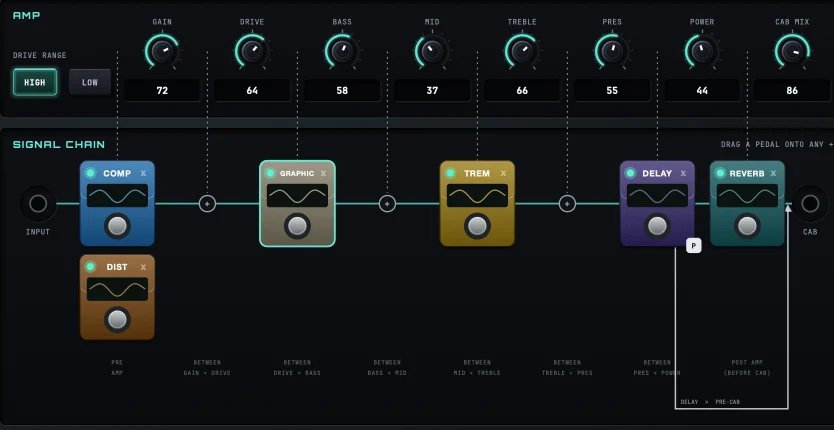
That is what G-Root and B-Root are - free, both of them - and the reason they can reach sounds a conventional amp sim cannot. B-Root adds a crossover so the sub can stay clean and compressed while the top gets hammered, which is a bass problem no pedalboard order solves.
If you want the pedals without an amp around them, Riggs is the board on its own: twelve pedals across four parallel lanes, where a lane can be fed from a point inside another one - so one lane is your front end and the rest branch off it, all running at once.
When to break the order
- Modulation before dirt - a phaser or flanger into a distorting amp is a classic sound, far more aggressive than the same pedal after.
- Reverb before dirt - distorting the reverb tail is unusable most of the time and enormous occasionally.
- Two dirt pedals stacked - the first acts as a boost into the second. Order changes which one's character dominates; try both.
- Delay in front - deliberately, for a washy sound, once you know that is what you are choosing rather than a mistake.
The list at the top is a default that reliably works, not a law. Once you know why each position is where it is, you know what breaking it will do.
Common questions
Should a compressor go before or after distortion?
Before, if you want consistent drive regardless of how hard you pick. After, if you want the amp to respond to your playing dynamics and only the output levelled. Both are standard - they produce genuinely different results rather than one being correct.
Why does my delay sound muddy through a distorted amp?
Because the repeats are being distorted along with the dry note, which pushes them back up towards the original's level instead of letting them decay. Put the delay after the distortion, or in the amp's effects loop.
Where does a noise gate go in the chain?
After whatever is generating the noise, which is usually the distortion. A gate in front of a drive pedal gates a clean signal and then the pedal amplifies the noise floor behind it.
Does pedal order really matter?
Yes, because each pedal processes the output of the one before it. Distortion into chorus and chorus into distortion are audibly different effects. The rule of thumb is to shape the tone first and add repeats and space last.
Tools for this
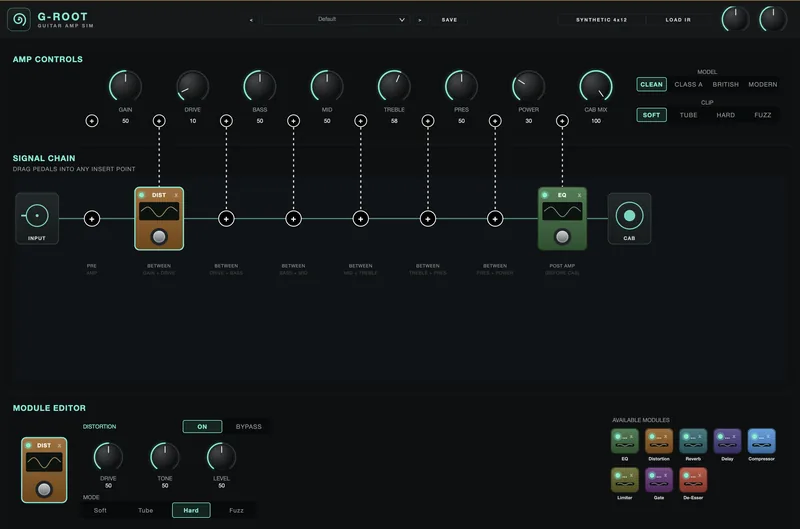
G-Root Guitar Amp Sim
FreePut your pedals anywhere in the chain, not just in front of the amp. Boost into the mids instead of the whole circuit, for sounds a normal amp sim can't get to.
View plugin →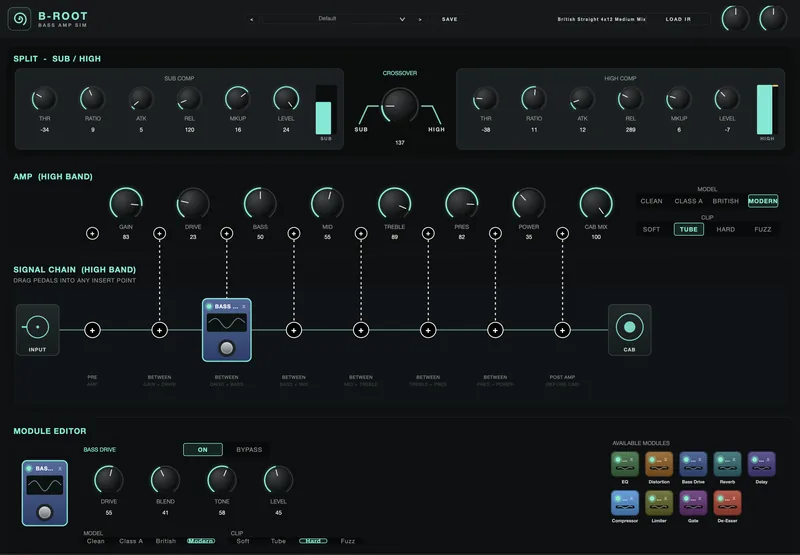
B-Root Bass Amp Sim
FreePedals anywhere in the chain, plus a crossover that keeps the sub clean and compressed while the top gets hammered. Low end that stays solid however hard you push.
View plugin →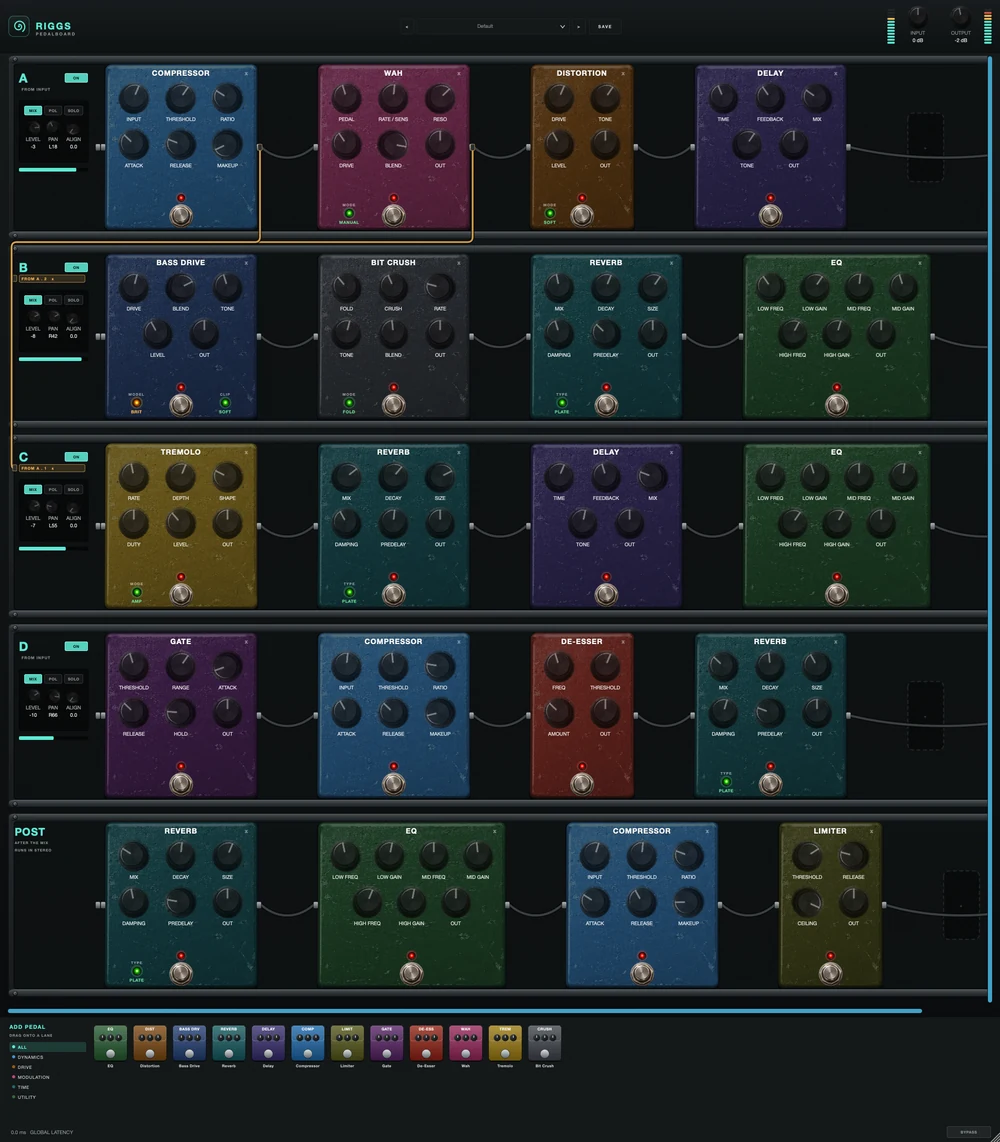
Riggs Pedalboard
£19Twelve pedals on a board you can split. Four parallel lanes, and a lane can be fed from a point inside another one - so one lane is your front end and the rest branch off it, all still running.
View plugin →