guide
Delay settings, and how to stop repeats cluttering a mix
A delay is set by three things: how long before the repeat, how many repeats, and what those repeats sound like. Sync the time to the tempo for rhythmic echoes or set it in milliseconds for slapback and thickening. Filtering the repeats is what keeps them out of the way of the original.
Time: synced or in milliseconds
Synced to a note value - quarter, eighth, dotted eighth - puts the repeats on the grid, so they reinforce the rhythm instead of fighting it.
The dotted eighth is the one worth knowing. It lands between the eighths, so it fills the gaps in a part rather than doubling what is already there, which is why it turns up on so many guitar and vocal parts. A quarter note delay lands on the beat and tends to thicken rather than add movement. A triplet setting cuts across a straight rhythm and immediately sounds busier.
Milliseconds is the right choice when the delay is doing something other than rhythm:
- 10-30 ms - not heard as a repeat at all. Doubling and thickening. Watch for phase cancellation against the dry signal at these times, and check in mono - see the phase guide.
- 80-140 ms - slapback. A single distinct echo, the classic rockabilly vocal and guitar sound. Add a little.
- 150-400 ms - reads as a genuine echo, and starts to interact with the tempo whether you sync it or not.
Feedback: how many repeats
Feedback routes the output back into the input, so each repeat generates another one, quieter each time.
- 0 % gives exactly one repeat. This is right far more often than people expect, especially on a busy arrangement.
- 20-40 % gives a few audible repeats that fade quickly. The usual setting.
- 60 %+ gives a long trail that overlaps itself. Use when the delay is the point rather than an accompaniment.
A trap worth naming: feedback plus a long time equals mud. Each repeat arrives before the last has gone, and they pile up into an undifferentiated wash. If you want a wash, a reverb does it better and more controllably - see the reverb guide.
Filtering the repeats is the important one
This is the setting that separates a delay that sits in a mix from one that clutters it.
A real echo loses high frequencies to the air and low frequencies to whatever it bounced off, so an unfiltered digital repeat - a perfect copy of the source, just later - sounds artificial and, worse, competes directly with the original for the same spectral space.
- High-cut the repeats, around 4-8 kHz. Each repeat should be duller than the last, which is what tells the ear it is a reflection rather than a second performance.
- Low-cut them, around 200-300 Hz. Low end in the repeats muddies the mix and adds nothing - the ear locates the echo from its mids and highs.
Whether the filtering sits after the delay or inside the feedback loop changes the character completely:
- After - every repeat is coloured identically. Controlled, predictable.
- Inside the loop - each repeat is re-coloured by the one before it, so the filtering compounds and the tail darkens progressively as it decays. That is how tape and analogue delays behaved, and it is why their trails sound like they are receding rather than just getting quieter.
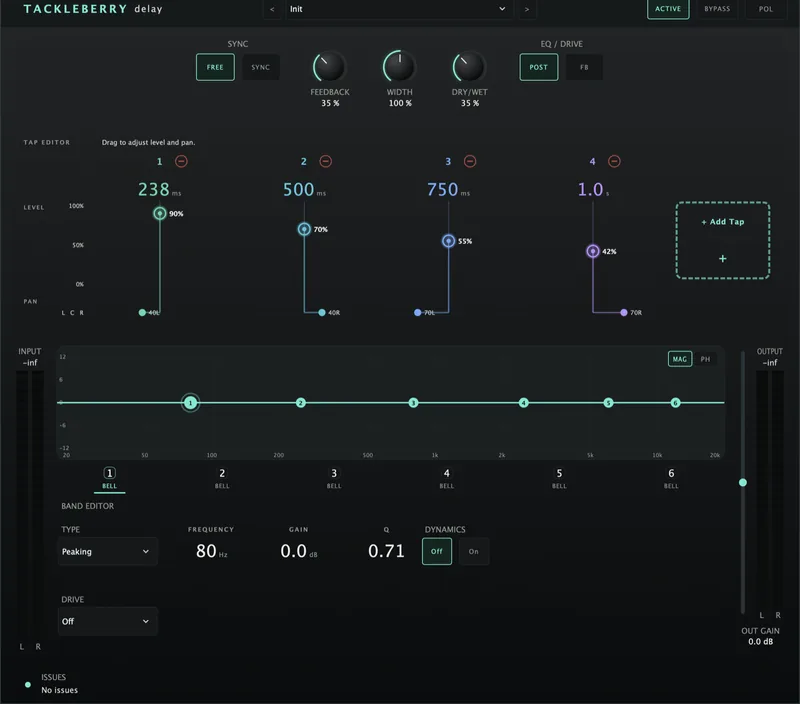
That second behaviour is the idea behind Tackleberry - eight taps, with a full EQ and distortion engine that can sit either after the delay or inside the feedback loop, so each repeat falls apart a little further than the last.
Keeping it out of the way of the vocal
Two techniques, both worth having:
Duck the delay. Sidechain the delay return from the dry vocal so the repeats drop while the singer is singing and come up in the gaps. The delay is clearly audible and never competes with a word. This is most of how modern vocal delays stay clean.
Time it to the gaps. A dotted eighth already does some of this by landing off the beat. Combined with ducking, the repeats effectively fill the spaces in the performance.
Delay as width
A short delay panned opposite the dry signal reads as width rather than as a repeat - the Haas effect, where the ear takes its directional cue from the first arrival and hears anything under about 30 ms as one wider event.
It works, and it comes with a warning: this is built out of a time offset, so summing to mono will comb-filter it, sometimes badly. Always check. If it collapses, a mid/side approach gives width that is mono-safe by construction - see the mid/side guide.
Common questions
What delay time should I use?
Sync it to the tempo when you want rhythmic repeats - a dotted eighth is the most useful starting point, because it lands between the eighths and fills gaps rather than doubling what is there. Use milliseconds for slapback, around 80-140 ms, or for thickening below 30 ms.
How much feedback is too much?
When repeats start overlapping before the previous one has faded, you have a wash rather than an echo, and a reverb would do that job better. On a busy arrangement a single repeat at zero feedback is often the right answer.
Why does my delay make the mix muddy?
The repeats are probably unfiltered. A perfect copy of the source competes with it for the same spectral space. High-cut the repeats around 4-8 kHz and low-cut around 250 Hz so each one is duller than the last, which is what real echoes do.
What is slapback delay?
A single short echo, roughly 80 to 140 milliseconds, with little or no feedback. It thickens a vocal or guitar and suggests a space without sounding like a distinct effect - the classic rockabilly and early rock and roll sound.