

The heavy one
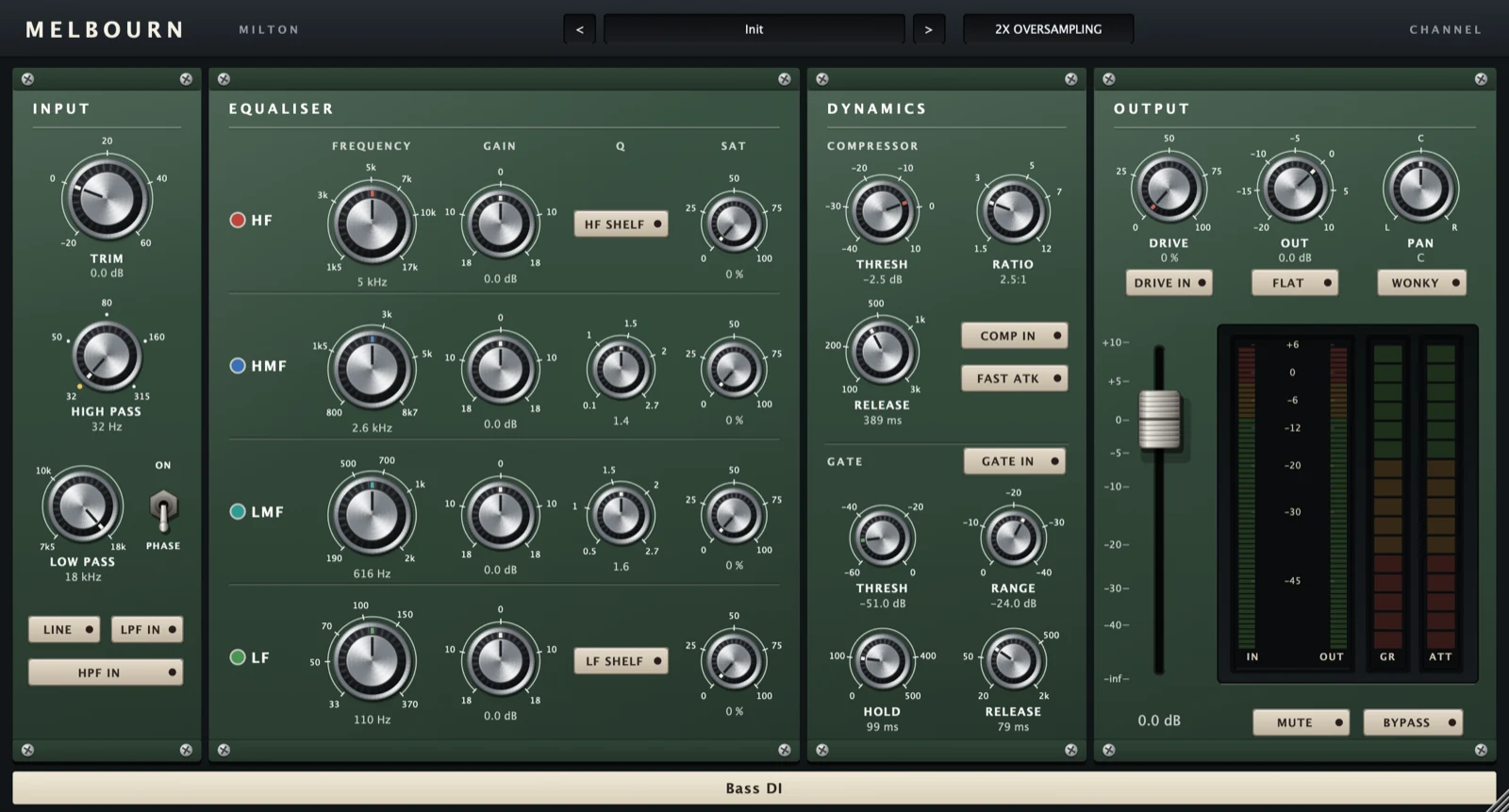
Melbourn is a console channel strip with transformers on the way in and on the way out, there to make a bottom end feel solid - a low end that sits still in the mix instead of blooming and fading with every note.
Push it and it thickens. Its amplifiers bend the signal lopsidedly, which adds even harmonics - the warm, rounded kind that make a kick or a bass feel bigger without making it brighter or harsher. The harder you lean on it, the more it gives back.
Turn up the saturation on the LF band and every hit picks up a little punch on its front edge - kick drums especially come alive. And because a loud hit bends further than a quiet one, the saturation breathes with the performance instead of sitting at one flat setting.
The hidden weight under the LF
There is no extra knob for this, and that is the point. When you boost Melbourn's LF band it does something an ordinary shelf cannot: the quiet low notes come up further than the loud ones. The gap between them closes, so the low end stops sounding loose and starts sounding dense and planted.
And if you cut the LF, it is just a cut: clearing mud never sets off anything you didn't ask for.
Broad and musical, or narrow and surgical
Four swept EQ bands, with shelf-or-bell switches on the outer two and a real Q knob on both mids, so you can go broad and musical or narrow and surgical. Underneath them, a high pass from 31.5 to 315 Hz takes out rumble before it reaches anything else.
Diode dynamics
A diode compressor with THRESHOLD, RATIO from 1.5:1 to 12:1 and RELEASE, plus a FAST ATK switch that drops the attack to 1 ms for grabbing transients. Make-up gain is automatic, so you set the compression by ear without chasing the level. A gate sits alongside it for tightening drums and cleaning up the bleed between hits.
Saturation on every band
No two analogue consoles ever behave quite the same, and part of their charm is the imperfection: a band that bends a little when you push it, a stage that roughens up before the rest. Saturation goes on every EQ band, and DRIVE does it for the amplifiers either side - so you can add grit at every stage of the channel, exactly where you want it and nowhere you don't.
Warm up the low mids of a bass without touching the top. Add grit to a snare's crack without roughing up its body. Give a vocal's presence some edge while everything else stays clean.
It behaves like a real gain stage, not a filter: a loud passage bends further than a quiet one, so the saturation breathes with the performance instead of sitting at one flat setting. On Melbourn it is thick and round - mostly even harmonics, and plenty of them. And at zero it is not there at all.
MIC or LINE, and DRIVE
DRIVE pushes the channel's amplifiers harder, and the output is level-matched - so turning it up changes the tone, not the volume. You hear exactly what the drive is doing, without being fooled by it simply getting louder.
The MIC / LINE switch decides how far it goes. LINE is the input stage as it is. Switch to MIC and DRIVE digs much deeper into the input, from gentle thickening near the bottom of its travel to real, obvious grit at the top. On Melbourn that grit comes out thick and warm.
WONKY: two sides that don't quite match
No console ever had two perfectly identical sides. Parts vary, tolerances drift, and left and right end up just a little different. That difference is a big part of why a real desk feels alive and a plugin can feel flat. WONKY puts it back.
Switch it on and the two sides of the channel stop matching: one comes out a shade fuller through the body and the top, the other a shade more forward in the mids. Pan a source away from centre and the quieter side loses a little body and reads a touch brighter. With the compressor in, each side compresses slightly differently too.
It leaves your low end alone. Everything WONKY does happens above 700 Hz, so the bottom octave of the two sides stays matched and nothing here can push your bass out of mono - which is exactly what you do not want happening in front of a limiter.
Then it drifts. Each side wanders on its own, differently and unpredictably, so the difference never settles into something your ears learn to ignore. What you get is movement - a subtle sense of life between the speakers that you feel more than you hear. It shows most on centred sources: kick, snare, bass, lead vocal.
Choose Wonky or Wonkier, or switch it off and both sides are identical again. It isn't a warmth control and it isn't an effect. It is the imperfection, on a switch.
Five shapes at the output
Sometimes a track doesn't need an EQ move - it just needs to lean. One button at the output cycles five gentle shapes: SMILE lifts the lows and highs together, FROWN does the opposite and pulls the focus into the middle, MID adds body, and HIGH opens up the top. FLAT leaves the signal exactly as it was.
They are broad and subtle on purpose, so they work like the character of a channel rather than another EQ to think about. Across a whole mix they add up: a few smiles on the right tracks can change the whole picture.
Where it shines
Kick and bass first: this is the channel for a low end that has to hold the whole track up. Then anything that should feel bigger and warmer rather than brighter - toms, electric guitars, a thin vocal that needs body. Put it across every track and each low end gets a little more solid, and that adds up.
Mixes that sound like nobody else
Milton gives you a console's character and then hands you the controls: grit on any band, two sides that drift apart, hidden character that responds as you push it, and a shape at the output for when a track needs to lean. Use as much or as little as the song wants.
It is the best of both worlds - the warmth, movement and happy accidents that make analogue feel alive, with the instant recall, precision and freedom of mixing in the box. The result is mixes that sound like nobody else's.